If you are a banker, payments professional, or just someone who is paying for service or goods, you probably think of Verification of Payee (VoP) as “a tick-box thing.” But in reality, it’s much more than that. At the heart of VoPis a deceptively simple problem: making sure that the account name and account number match. And while that sounds easy, the reality is far messier. Names are inconsistent, spellings vary, and people don’t always input exactly what the bank holds on file.
This is where the matching algorithm on the responding side becomes critical. A strong algorithm doesn’t just prevent errors, it keeps payments flowing seamlessly you’re your customers’ accounts. Fewer no-match or close-match results mean that money reaches its intended recipient quickly, without the payer hesitating or stopping a payment mid-flow. That’s not just convenience. It’s trust, operational efficiency, and customer satisfaction rolled into one.
What Makes Matching “Better”?
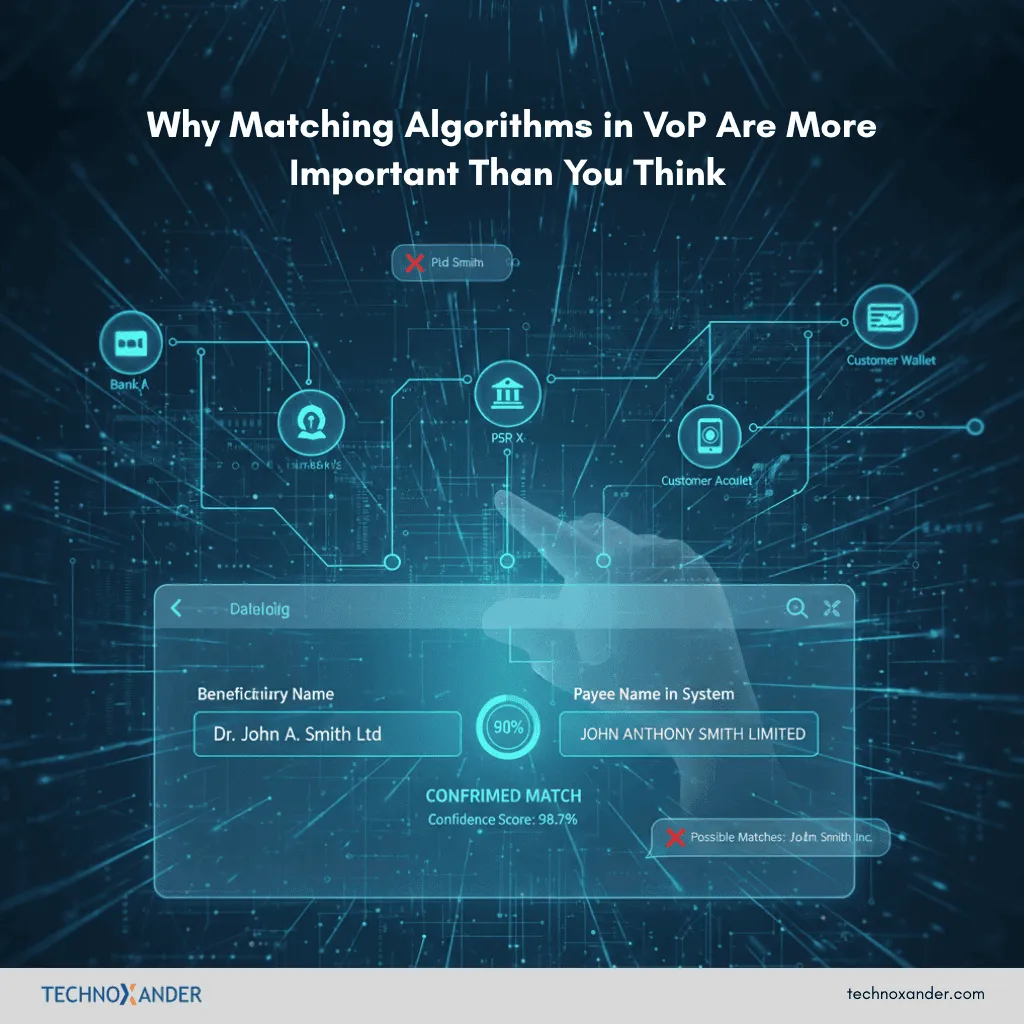
Many VoP implementations simply rely on Levenstein distance, a classic string comparison method, for matching. It works for simple cases, but generates many false positives in real production environments. Because Levenstein might tell you how many characters differ between two names, but it doesn’t understand context. Is “Ltd” a critical part of a company name? Should “Dr” in a personal name be ignored for matching purposes? Can subtle differences in diacritics or punctuation change the match confidence?
Better matching happens when we layer in advanced techniques:
- Business descriptors: Differentiating between corporate suffixes like “Ltd”, “PLC”, or “GmbH” and recognising that they often don’t impact the intent of the match.
- Personal honorifics: Accounting for titles such as “Dr”, “Mr”, “Ms”, or “Prof” in personal names to avoid false mismatches.
- Customisable thresholds and confidence scores: Different banks have different risk appetites. Some may want extremely strict matching for corporate payments, while others may tolerate minor variances for consumer payments. Assigning confidence scores for each type of name allows us to balance accuracy and flow.
- Nicknames, Aliases or Trading Names: Taking into context nicknames, trading names or aliases when matching result into less false positives.
- Context-aware matching: Combining string similarity with known patterns, boosting confidence if first few characters match and thinking if a human would consider the strings a match.
The result? A system that understands the difference between a real mismatch and variation in a name, keeping payments moving while reducing friction for both payers and payees.
Why Matching Algorithms in VoP Matters
The first few thoughts when thinking about VoP is the implementation speed, compliance and pricing. There is very thought given to: What happens after implementation in production?
Accuracy of matching and reliability then become a point of discussion.
In production when millions of payments are being processed at speed and in real-time, small mismatches become costly. These false positives lead to:
- Customer frustration: Payments don’t flow into customers’ accounts as expected. The payer abandons the payment mid-journey due to minor mismatches leading to calls, emails, and complaints.
- Operational overhead: Your payments or compliance teams start raising tickets for clarifications and commence the costly investigations to establish mismatches that aren’t really mismatches.
- Reputational risk: Customers equate failed payments with unreliability. One big payment, which could keep your customer balance positive and not being executed as expected, can erode trust built over years.
A robust, smart, advanced matching algorithm in vop is not just a technical feature. It quickly becomes part of the bank’s promise to its customers: money moves when it should, accurately and reliably.
How We Help Our Clients with VoP?
Our first goal is to make the bank compliant in as little time as possible. But we don’t stop when integration of our VoP solution with your infrastructure is complete.
We work with you to minimise false positives in matching so your customers can continue to receive money as expected.
Now, every bank has its own way of naming accounts, holding data on file, and its own risk appetite. We work closely with each bank to:
- Set up business descriptors and personal honorifics that reflect how their customers and counterparties actually name accounts. Now, this becomes important as honorifics can make ton of difference when matching for retail customers and descriptors can help with matching for corporate customers.
- Configure algorithms to suit the bank’s risk profile, balancing compliance and business needs for both personal and corporate payments.
- Help with confidence scores allowing banks to stay within their risk appetite.
- Continuously monitor and report on matches, no-matches, and close-matches, so the bank knows exactly where adjustments are needed. And what’s more, you don’t have to raise a ticket to obtain this data. It is available on the self-service dashboard.
On the requesting side, where we have initiated checks and other PSPs have responded with matching results, the matching percentage is sometimes as low as 35–45%.
Whereas on the responding side, where we are responding with matching results, our confirmed matches consistently fall in the 75–90% range is not a coincidence.
This is a direct outcome of an algorithm which understands your business, relevance, and not just raw overlap.
This means fewer false positives, clearer outcomes, and decisions you can trust.
The Bottom Line
Name Matching in VoP solutions appear deceptively simple on sales decks and in calls but are highly complex to implement in production grade environment where scale, availability and performance matter. Smart algorithms are a must for faster payments, fewer complaints, and less operational friction. And in the long run, reliability will matter far more than the lowest price or the fastest implementation.
Anyone can be fast or cheap. Not everyone can be right when it counts. Not everyone can say with confidence on false positives generated. This is why we obsess over matching because every payment that reaches the right account without a second thought builds trust, efficiency, and confidence in the system as a whole.
About Author: