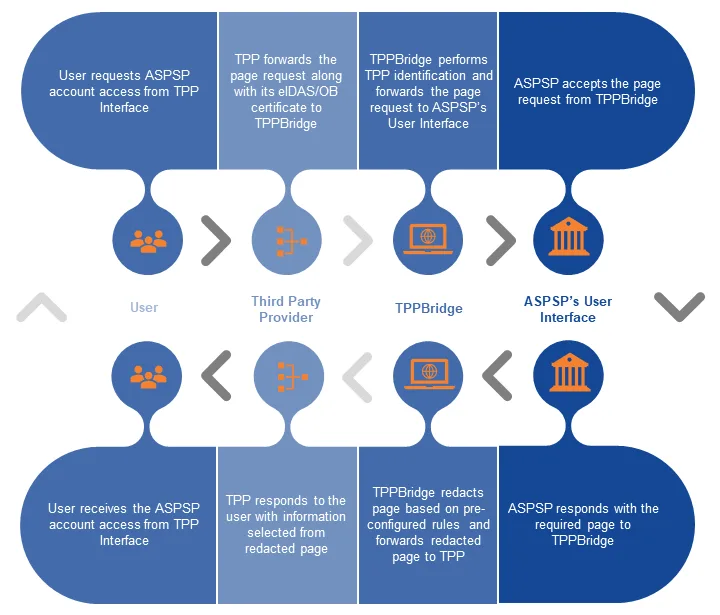
TechnoXander’s TPPBridge is the contingency Mechanism (also known as modified customer interface or Fallback Mechanism) which can be used by banks and institutions which do not have a working Open Banking Dedicated Interface or have failed to obtain Contingency Mechanism exemption from FCA. TechnoXander TPPBridge allows for access to banks online banking after TPP Identification. TPPBridge is compliant with UK finance interpretation of Contingency Mechanism. Bank users can set up rules for access to TPP’s based on roles via an intuitive and easy to use front end reducing the need for our involvement after initial deployments is complete. TPPBridge has a very small footprint and has no impact on any existing systems in bank.

Under PSD2 and the UK Payment Services Regulations, any bank that has not obtained FCA exemption from providing a Contingency Mechanism must implement a fallback access route for regulated Third Party Providers (TPPs). Without a Contingency Mechanism, your institution risks regulatory sanction from the FCA and TPP complaints. TPPBridge enables eIDAS and OBWAC-authenticated TPP access to your online banking environment without disrupting existing systems, implemented in 3–4 weeks with a minimal technical footprint.

- Complete formalities
- Implementation discussion
- Agree deliverables
- Deployments
- Set up rules
- Support and maintenance
Get started quickly with simple guides, a risk-free sandbox environment, real-time insights, and ready-to-use SDKs and plugins for seamless integration.
In EU, ASPSPs that offer to a payer a payment account that is accessible online are required to have in place at least one interface which allows AISP, PISP and CBPII access to customer data.
ASPSPs which provide access through a dedicated interface but have not received an exemption from regulatory authorities are required to have a contingency mechanism in place for TPP access.
Banks should implement contingency mechanism as a short term measure to become regulatory compliant.
In UK, FCA has mandated ASPSPs to enable TPP access via dedicated interface. ASPSP’s who are unable to obtain exemption from contingency mechanism will need to implement Contingency Mechanism/Fall back mechanism.
Screen scraping is the process of collecting screen display data from e-banking and translating it so that TPP can display it to the customer in its application. So, screen scraping is a data-access method that logs TPP into e-banking using customer’s personal banking username and password as if they were a customer.
Many TPPs in UK were screen scraping before PSD2 and banks were not required to identify them. With contingency mechanism, TPPs will need to identify themselves with OBWAC/eIDAS certificates.
A Dedicated Interface is a purpose-built API that allows TPPs to access customer account data in a structured way. A Contingency Mechanism, also called a fallback or modified customer interface, provides TPP access via the bank's existing online banking channel when the Dedicated Interface is unavailable or when the bank has not obtained an exemption. TechnoXander provides both solutions.
Yes. TPPBridge is frequently implemented as an interim compliance measure. TechnoXander supports a transition path from TPPBridge to a full Dedicated Interface, allowing banks to achieve compliance quickly while planning a longer-term API programme.
We offer both Native and SaaS hosting options. We can implement Contingency Mechanism in 3-4 weeks.
Join Our Newsletter for the Latest Updates.
Tell us what you are interested in and we will be in touch to arrange a demo.
Your request has been sent to the TechnoXander team, and we look forward to speaking with you soon.
In the meantime, explore our solutions.
Explore Solutions →