What Is FRIDA?
A fraudster opens an account at one payment service provider (PSP). A victim at a second PSP sends money to it. The funds then leave through a third.
Each PSP sees only part of the activity. No single PSP sees the full pattern.
FRIDA, the Fraud Information Distribution Arrangement, is designed to close that gap. It is a scheme from the European Payments Council (EPC) that sets common rules for PSPs to share fraud data with each other. On 11 September 2026, the EPC published the draft FRIDA Rulebook (EPC108-26, v0.1) and opened a public consultation on it.
This article explains what FRIDA is, how it works and what it means for PSPs.
Is FRIDA a fraud detection system?
No. FRIDA does not decide what is suspicious, and it does not tell PSPs how to act. The rulebook also says it “is not a payment means or a payment instrument.” FRIDA sets the rules for how fraud information moves between PSPs. Detection and investigation stay with each PSP.
What Does the EPC FRIDA Scheme Actually Share?
The item PSPs share is called a Fraud Alert. A PSP raises one when it has objectively justified reasons to suspect fraud. In most cases, it names an account, by IBAN, that the PSP suspects is involved in fraud.
Every alert carries a small mandatory core: who raised it, which account it concerns, which PSP holds that account, the type of fraud and the alert’s current status, such as Suspicious or Confirmed Fraud. Further detail, such as transaction or device data, is optional. We cover this in depth in what goes into a FRIDA fraud alert.
An alert is a shared record, not a one-off message. The Sending PSP can update or cancel it over its life. The PSP that holds the reported account can add its own view, and other receiving PSPs can add a predefined comment based on activity they have seen.
Why Now? PSR Article 83a Fraud Data Sharing
The driver is the EU Payment Services Regulation (PSR). Its Article 83a is the fraud data sharing provision: PSPs will be required to take part in a fraud data sharing arrangement. FRIDA is the EPC’s version of that arrangement.
The PSR had not been formally adopted when the draft appeared. The Council published its final compromise text in April 2026, and the rulebook is based on it. The EPC will align the final version once the regulation is published. The EPC’s consultation announcement sets out the timeline.
| Milestone | Timing |
| Draft rulebook v0.1 published | 11 September 2026 |
| Public consultation on v0.1 | 11 September – 10 December 2026 |
| Rulebook v1.0 and technical specifications (EPC target) | May–June 2027 |
| FRIDA takes effect, with the PSR | Expected Q4 2028 |
The rules are being set now. The obligations apply when the PSR takes effect. For PSPs that already went through Verification of Payee, the pattern will feel familiar: an EU regulation sets the duty, and an EPC scheme sets the rules.
Can PSPs comment on the draft?
Yes. The EPC invites feedback on v0.1 using its response template. Comments must reach the EPC by midnight Brussels time on 10 December 2026, and late responses are not considered. Details are in the consultation announcement.
How Does FRIDA Work?
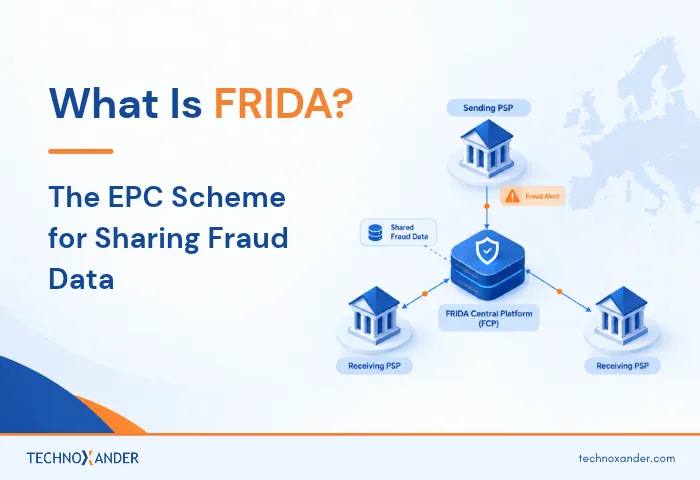
How FRIDA works: a Sending PSP shares a Fraud Alert through its FIP to the FRIDA Central Platform, which distributes it through FIPs to all Receiving PSPs
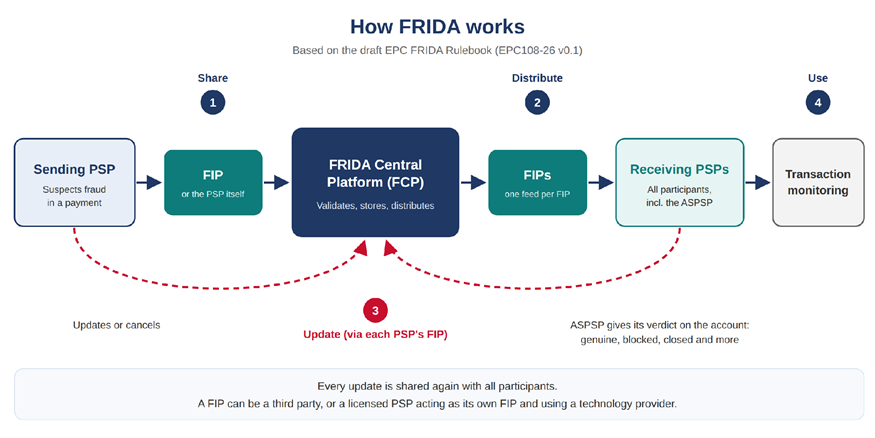
The flow starts when a PSP involved in a payment suspects fraud. That PSP becomes the Sending PSP and shares a Fraud Alert.
The alert does not go straight to other banks. It travels through a Fraud Information Platform (FIP) to the FRIDA Central Platform (FCP). The FCP checks it, stores it and passes it to every connected FIP. Each FIP then delivers it to the PSPs it serves. These are the Receiving PSPs.
One Receiving PSP will usually be the ASPSP, the account servicing PSP that holds the reported account. It can give its own view, for example that the account is genuine. The Sending PSP can update or cancel the alert as its investigation develops.
What does the ASPSP’s verdict mean?
The ASPSP knows the reported account best, because it holds it. FRIDA lets it record its own verdict on that account inside the alert. The rulebook calls this the account’s stage. It can be Genuine, Suspicious, Confirmed Fraud Suspicion, Fraudulent, Blocked or Closed.
Say Bank A raises an alert on an IBAN held at EMI B. If EMI B knows the customer is legitimate, it can mark the account Genuine. If it has frozen a mule account, it can mark it Blocked. Every participating PSP then sees both views: Bank A’s suspicion and EMI B’s verdict.
This is separate from the alert’s status, which only the Sending PSP sets. The ASPSP does not have to respond, but the rulebook strongly recommends it does, especially when the account is genuine.
Every update is shared again with everyone. Each PSP then feeds what it receives into its own transaction monitoring.
A FIP can be a third party. It can also be the PSP itself. A licensed PSP can act as its own FIP and use a technology provider to build and run the connection. Our guide to FRIDA roles explains each actor in detail.
How Is FRIDA Different From Fraud Sharing Today?
Most PSPs already share some fraud intelligence. The difference is in how.
| Fraud sharing today | Under FRIDA | |
| Channel | Calls, emails, local forums | One EPC scheme and central platform |
| Data | Whatever each party chooses | A defined dataset with a mandatory core |
| Reach | Bilateral or national | Every participating PSP |
| Updates | Often one-off | Status and account stage tracked over time |
| Obligation | Largely voluntary | Mandatory for in-scope PSPs |
What changes is that fraud data sharing will follow one rulebook, one data model and one platform across the EEA.
What Is FRIDA Designed to Achieve?
The rulebook sets out five objectives. FRIDA should give PSPs common standards for sharing fraud data, and automate those exchanges so little manual work is needed. It should provide a central platform to distribute alerts and manage their life cycle. Security, privacy, low risk and cost efficiency must be built in. And the scheme must be able to grow as regulation changes.
The expected benefits are practical. Transaction monitoring should become more accurate. Fraud should be spotted faster. And public trust in SEPA payments should rise as the whole ecosystem improves.
Shared alerts only create value if PSPs can use them, both to sharpen detection and to give investigators better context. As we argued in the next phase of AML, more signals are not enough on their own. What matters is how they reach the people making decisions.
What Is Inside the FRIDA Rulebook?
The rulebook follows the familiar EPC structure. The first two chapters cover the scheme’s purpose, scope and actors. Chapter 3 holds the business rules: process flows, datasets and data fields. Chapter 4 sets out rights and obligations, including eligibility, opt-outs and liability. Chapter 5 covers governance and change management.
The annexes add the adherence agreement, the rules for FIPs and a restricted risk management annex.
What Does FRIDA Mean for PSPs?
For PSPs in the EEA that take part in one or more EPC payment schemes, joining FRIDA is mandatory, with only limited opt-outs. Other PSPs in the PSR’s scope can join voluntarily. Our next article covers who must join FRIDA in detail.
Participants must both send and receive alerts. They must also feed what they receive into their monitoring. For most fraud teams, this replaces informal sharing with a defined, auditable process.
The draft may be refined before it is final. The obligation to share fraud data comes from the PSR itself. Three steps make sense now:
- Read the draft rulebook and send comments to the EPC before 10 December 2026.
- Map your own fraud cases to the FRIDA alert dataset.
- Decide how you will connect: through a third-party FIP, or as your own FIP with a technology provider. FIP qualification rules are still being finalised.
FRIDA will connect every participating PSP in SEPA. The TechnoXander FRIDA Fraud Gateway is designed to link the FRIDA Central Platform to the fraud systems you already run. It follows draft rulebook v0.1 and will be updated as the EPC finalises v1.0. Book a demo to see how.
About Author: