What is the next phase of AML maturity?
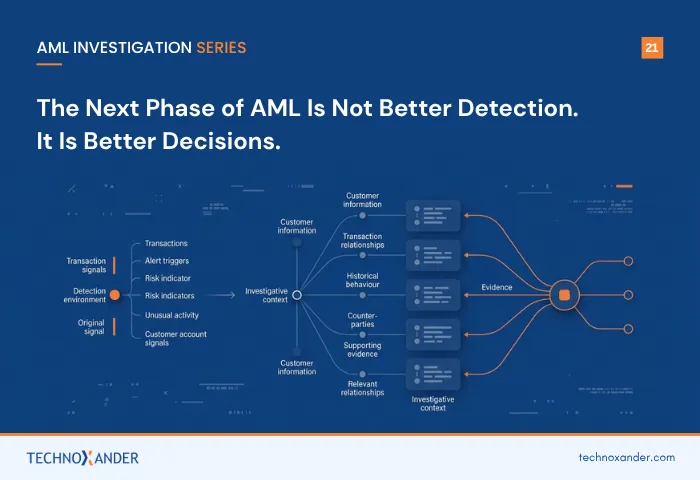
It is the shift from investing in detection, catching more risk signals, to investing in investigation quality: the infrastructure that turns an alert into a consistent, well-reasoned, defensible decision. Detection tells a firm what to look at. Investigation quality determines whether the decision made about it would survive regulatory scrutiny, and that AML investigation infrastructure has lagged a decade behind detection investment in every market this affects.
Over the course of this series, one argument has run beneath every article: AML systems optimise for detection. Investigators optimise for decisions. Those are not the same thing.
The industry has spent a decade, and substantial capital, making detection better. That investment has not been wasted. It has produced genuinely meaningful advances: more precise transaction monitoring models, better entity resolution, faster sanctions screening, more sophisticated behavioural analytics. The alert generation layer of AML compliance technology is meaningfully stronger than it was ten years ago.
And yet the compliance outcomes that regulators examine, investigation quality, decision consistency, SAR utility, audit trail depth, have not improved at the same rate. In many firms, they have not improved at all. The reason is structural, not accidental. The industry invested in detection and assumed that better detection would translate into better outcomes. It does not, automatically, because detection and investigation are different problems requiring different infrastructure.
Why doesn’t better detection automatically produce better compliance outcomes?
Because detection and investigation solve different problems. Detection decides what gets flagged. Investigation decides what the firm does about it, and that requires context, consistency, and a defensible record, none of which a better flagging model supplies on its own. A firm can improve detection for a decade and still have the same fragmented AML investigation process underneath it.
What the Detection Era Got Right
Before arguing for what comes next, it is worth being honest about what detection investment achieved, because the answer is: quite a lot.
Transaction monitoring systems evolved from simple rule sets to sophisticated behavioural models capable of identifying complex typologies across large transaction volumes. Sanctions screening improved in speed and accuracy. Adverse media monitoring became real-time and global. Entity resolution across disparate data sources became more reliable. The probability that genuinely suspicious activity goes undetected in a well-configured AML programme is materially lower than it was a decade ago.
That is a genuine compliance achievement, and the detection layer is doing what it was designed to do with increasing effectiveness. The problem is what happens after the alert is generated, and that problem has been systematically under-invested in while the industry focused on AML detection technology.
Where the Next Decade of Investment Needs to Go
| Dimension | Where detection-era investment focused | Where investigation-era investment needs to go |
|---|---|---|
| Context | More signals feeding the alert | Full customer picture assembled before analysis |
| Consistency | Better models, same manual reasoning | Structured analysis applied the same way every time |
| Memory | Alerts logged, reasoning discarded | Prior reasoning retrievable at the next similar case |
| Evidence | A disposition code and a timestamp | Traceable rationale that holds up under scrutiny |
The Decade-Long Investment Gap
Across this series, the same operational reality has surfaced in different forms: investigators spending the majority of their investigation window on data retrieval rather than analysis, institutional knowledge held in senior analyst experience rather than embedded in workflow, new investigators cold-starting every case, SAR narratives assembled under time pressure from partial customer pictures, and case records that capture what was decided but not why.
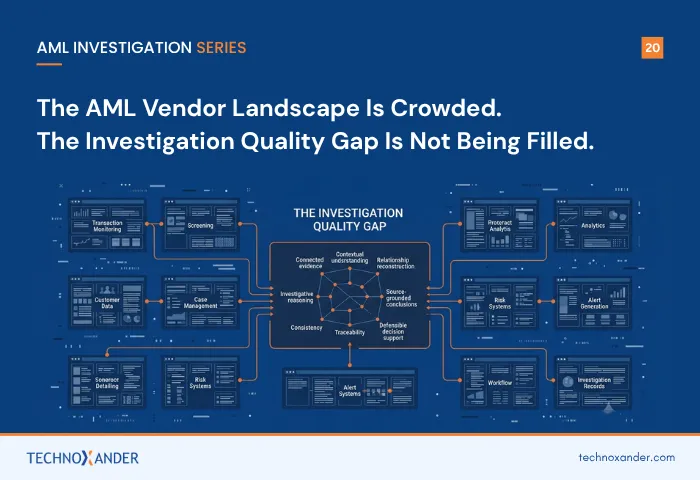
These are symptoms of a shared root cause: the AML investigation layer has not received proportionate investment. Case management systems were built to route and track alerts, not to support the analytical quality of the investigation happening inside them. The infrastructure that determines compliance outcomes, context assembly, institutional memory, structured investigative analysis, traceable investigative rationale, is largely absent from the standard AML technology stack.
Industry benchmarking research has identified this imbalance directly: compliance investment is disproportionately concentrated in the detection layer, while the investigation layer, where compliance decisions are actually made, remains structurally underdeveloped. The result is a compliance architecture that is strong at generating alerts and weak at resolving them to a defensible standard.
The uncomfortable truth at the heart of this series: A firm can have best-in-class transaction monitoring, a mature sanctions screening programme, and a fully documented case management workflow, and still be producing investigations that a regulator would find inadequate. Investigation quality is not a function of detection sophistication. It is a function of investigation infrastructure, and most firms do not have it.
What the Next Phase of AML Maturity Looks Like
The five investigation quality dimensions established earlier in this series, investigative completeness, decision consistency, institutional memory, SAR quality, and audit trail depth, are the architecture of the next phase of AML maturity. They are not aspirational. They are increasingly the standard against which regulators everywhere are measuring compliance programmes.
Investigative completeness means the full customer picture is assembled before analysis begins, without navigating to separate systems. Decision consistency means comparable cases produce comparable outcomes regardless of which investigator handles them, through structured analysis rather than individual experience at scale. Institutional memory means every closed investigation contributes to a retrievable knowledge base, so the cold-start problem stops repeating with every new hire. SAR quality means filing narratives that give the NCA, or the equivalent financial intelligence unit elsewhere, enough information to act on. Audit trail depth means every decision carries traceable investigative rationale, a record that can be defended eighteen months later when a supervisor asks why.
The Regulatory Direction of Travel
The regulatory trajectory is clear, and it points directly at the investigation quality layer, in the UK and beyond it.
The FCA’s approach to model governance in AML increasingly requires firms to demonstrate not just that AI and algorithmic tools are producing outcomes, but that those outcomes can be explained and human accountability maintained. The EU AI Act requires explainability, human oversight, and documented decision rationale for high-risk AI systems in financial services, and US federal model risk management expectations together with emerging Middle East AI governance frameworks are converging on the same substance. FATF guidance on AI in AML reinforces the same principle internationally: AI tools should augment investigator judgement, with firms able to demonstrate the basis for the decisions those tools help produce.
These converging expectations are not coincidental. Detection failures are becoming less common as detection tooling improves. Investigation quality failures, shallow reasoning, inconsistent decisions, indefensible audit trails, are becoming the dominant exposure, in every market these regulators cover. Regulation is following the risk.
The Strategic Investment Decision
Firms that invest in investigation quality infrastructure now are building a compliance advantage that is fundamentally harder to commoditise than detection model performance. Detection models can be matched by competitors and improved iteratively by anyone in the market. A firm’s institutional memory, the accumulated reasoning from thousands of closed investigations embedded in the workflow, cannot be acquired off a shelf. A compliance culture where decision consistency is structurally embedded rather than dependent on individual experience is not replicable in a procurement cycle, and audit trail depth that can demonstrate investigation quality under regulatory scrutiny is not a feature that gets switched on. It is built over time, through the systematic capture of investigative rationale at every case.
The firms that will lead on AML compliance in the next decade are not the ones with the most sophisticated detection layer, though detection will remain important. They are the ones that recognise the AML investigation quality gap for what it is: not a tooling limitation to be worked around, but an infrastructure problem to be solved, wherever they are regulated.
This series has argued, across twenty articles before this one, that the next phase of AML belongs to investigation quality. The detection era was necessary. It improved the industry in real and measurable ways. But detection without investigation quality is a system that catches more cases and does less with them. The compliance outcome is determined by what happens after the alert: by the quality of the reasoning, the consistency of the decision, and the depth of the record that defends it.
That is what investigation intelligence is for, and that is what the next phase of AML investment should be building toward.
At TechnoXander, we have built the AML Investigation Intelligence Platform for exactly this next phase, structurally addressing investigative completeness, institutional memory, decision consistency, SAR quality, and audit trail depth for regulated firms across the UK, US, EU, and Middle East. If your firm is ready to move from detection investment to investigation quality investment, we would like to be your partner for that transition.
About Author: