What is organisational memory in AML?
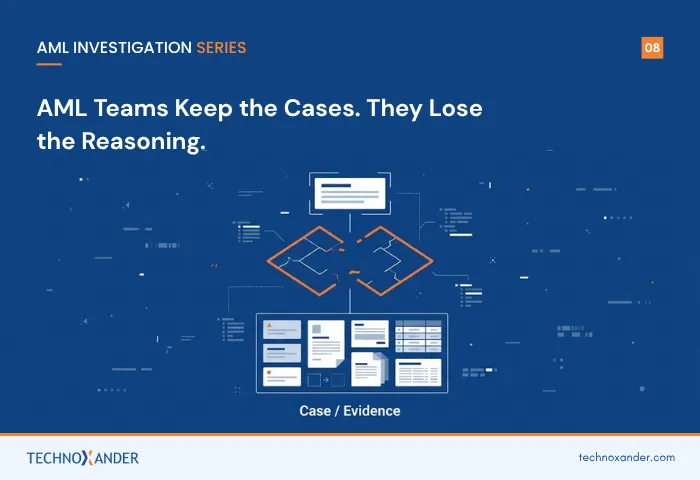
Organisational memory in AML is the accumulated reasoning behind an institution’s past investigation decisions, not just the closed case records, but why each was closed or escalated. In most AML teams it lives in unsearched case notes and in the heads of experienced investigators, so it is rarely available to the next analyst who opens a similar alert.
An investigator closes a case: a cross-border contractor receiving frequent inbound EUR payments, six prior alerts, five closed non-suspicious and consistent with documented income, one escalated then de-escalated after onboarding documentation confirmed the pattern. The notes sit in a case management field nobody will search unless a future investigator happens to use exactly the right identifier.
Three months later, a different investigator opens a new alert on the same account type. Different customer, same profile, same behaviour. They start from nothing. The institution knows how to handle this. The investigator just doesn’t know that the institution knows.
What Institutional Memory Actually Is
In most AML investigation environments, institutional knowledge lives in two places: closed case records that are rarely searched, and the heads of experienced investigators who have seen enough patterns to know what matters. Both are fragile.
The issue is not storage. AML teams already store enormous amounts of case data. The issue is retrieval: most AML case management platforms store investigations, but very few operationalise them. A case closed fourteen months ago, with a disposition note explaining exactly why a specific payment pattern was consistent with a legitimate business model, is effectively invisible to the investigator opening a similar case today.
Senior analyst expertise is more fragile still. When an experienced investigator moves to another firm, they take years of pattern recognition with them: judgements about how specific customer types behave, which typologies recur in certain market segments. The next analyst starts from scratch. The institution has not lost the cases. It has lost the reasoning behind them.
What Institutional Memory Loss Looks Like vs. What It Should Look Like
| Dimension | Without organisational memory | With organisational memory |
|---|---|---|
| New alert, familiar pattern | Investigator starts from a blank case | Investigator sees the three most relevant prior dispositions automatically |
| Senior analyst leaves | Their pattern recognition leaves with them | Their reasoning stays retrievable in the system |
| Decision consistency | Varies by which analyst handles the case | Grounded in the institution’s documented history |
| Cost over time | Every similar case pays a retrieval tax again | Each closed case makes the next one faster |
Why does losing organisational memory create regulatory risk?
The FCA’s Financial Crime Guide expects firms to apply AML decisions consistently and be able to defend them. When institutional reasoning is not retrievable, two investigators can reach different conclusions on similar cases for no reason other than who happened to handle each one. In a function where consistency of decision-making is a regulatory expectation, the FCA’s Financial Crime Guide expects firms to have systems and controls that ensure decisions are consistent and defensible, so dependence on individual memory is a structural vulnerability, not just an operational inconvenience. The specific guidance differs by market, but US, EU and Middle East AML frameworks share the same underlying expectation: consistent, defensible decision-making, not decision-making that depends on which analyst was on shift.
The Cold-Start Tax
Every investigation that begins without institutional context pays a cold-start tax. The investigator retrieves basic account data, searches manually for prior cases, and reconstructs the customer’s history from disparate systems. The decision they reach may be sound, but it is informed by whatever they managed to surface in the time available, not by the full pattern of how this customer type has been handled across the institution.
That tax compounds when alert volumes rise, and compounds further when staff turn over and the analysts handling cases are less experienced than the ones who built the institution’s knowledge base in the first place. Knowledge transfer and consistency of investigation quality are recurring drivers of operational cost in AML teams, not alert volumes or false positive rates on their own, but the cost of repeatedly solving problems the institution had already solved.
What AI-Powered Organisational Memory Changes
The shift that AI-powered case memory enables is not automation. It is retrieval that is structured, searchable, and delivered at the point it is needed.
How does AI-powered case memory change what an investigator sees?
Instead of opening a blank case, the investigator sees the current alert alongside the most relevant prior investigations, matched by customer profile or typology, with the reasoning behind each disposition already surfaced. When a system retains the reasoning behind closed cases, not just their disposition status, the next investigator does not see a blank slate.
Does this replace the analyst’s own judgement?
No. The analyst still makes the decision. Organisational memory changes how much of the institution’s own history is available to inform that judgement, not who exercises it. A new investigator joining in month one has access to the institution’s accumulated intelligence from day one, and a senior analyst approaching retirement does not take that expertise with them when they leave. Most AML knowledge does not disappear. It just never reaches the next investigation at the right moment.
The Consistency Argument Regulators Care About
Two investigators reviewing the same customer type should reach consistent decisions, or where they diverge, the divergence should rest on case-specific facts rather than differences in personal experience. The JMLSG Part I guidance is clear that firms should apply risk assessments in a consistent, documented manner. A compliance function where investigation quality varies significantly by which analyst handles a case carries a consistency risk.
AI-powered organisational memory creates the conditions for consistent decision-making without mandating it: the institutional baseline, how the firm has historically treated this profile or typology, is available to every investigator equally, not just to those who worked the prior cases themselves. For a regulated firm under close supervisory attention, that is the difference between a compliance programme that scales with the business and one that degrades as it grows.
At TechnoXander, our AML Investigation Intelligence Platform retains and surfaces institutional case knowledge at the point of every new investigation, so each analyst benefits from everything the institution has already learned, from their first day. Speak to our team to see how investigative memory works in practice.
About Author: