What is Retrieval-Augmented Generation (RAG)?
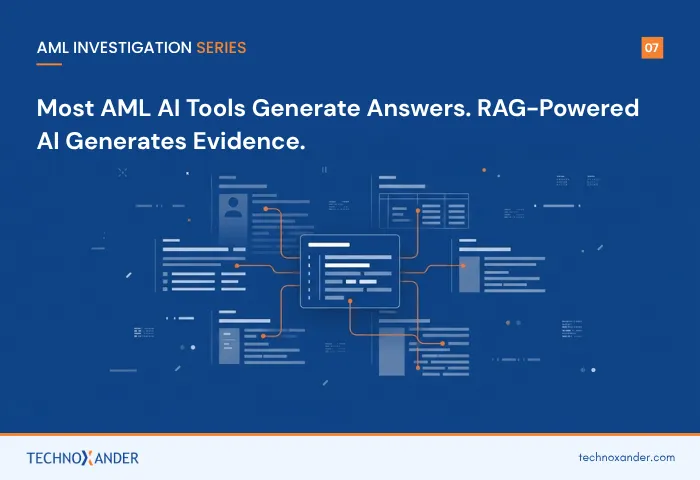
RAG is an AI architecture that grounds generated outputs in retrieved information rather than a model’s trained parameters alone. Before generating a SAR narrative or case analysis, a RAG system first retrieves the customer’s prior case history, applicable policy and typology references, then builds the output from that retrieved material. A generic LLM answers from memory. A RAG system answers with references.
Most financial crime professionals have encountered AI tools that generate fluent, confident outputs with no traceable connection to the institution’s actual data. The SAR narrative sounds right. Ask the system where it got that from, which prior case, which policy reference, which customer record, and the answer is unclear.
That is not an AML investigation tool. That is a text generator in a compliance wrapper, and in AML investigations, hallucinated reasoning is not an inconvenience. It is a governance risk.
Why This Matters at the Point of Investigation
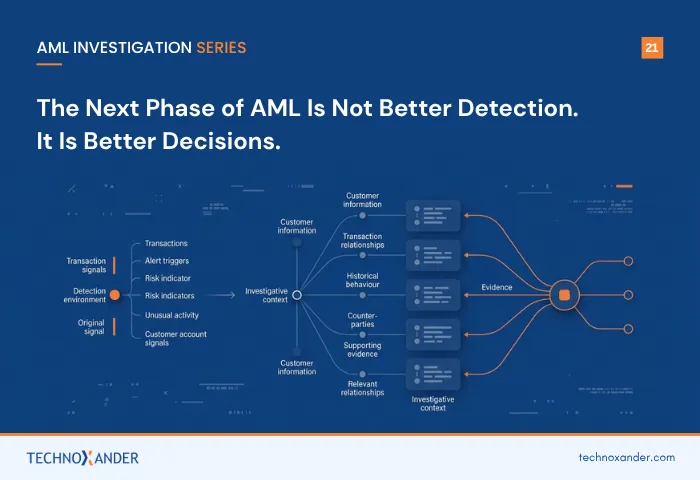
AML investigation is not a general-knowledge problem. It is a retrieval problem. The information that determines whether an alert represents genuine risk, the customer’s transaction history, their onboarding risk rationale, the pattern of prior case dispositions, already exists inside the institution. The investigator’s job is not to invent an explanation. It is to retrieve the relevant picture and apply judgement to it.
Many AI investigation tools can generate convincing narratives without retrieving a single piece of institution-specific evidence. They look capable in a demonstration. They become a problem when the FCA asks for the basis of a decision.
Why is a RAG-grounded output more defensible than a generic AI output?
Because every sentence can be traced back to a specific case record, policy clause, or typology reference the system actually retrieved. A generic AI narrative may sound equally confident but cannot be verified against what the institution actually knows.
Generic LLM Output vs. RAG-Grounded Output
| Dimension | Generic AI narrative | RAG-grounded narrative |
|---|---|---|
| What it references | Nothing the institution holds | Specific prior cases, policy clauses, typology guidance |
| Can the investigator verify it? | No, the reasoning cannot be traced | Yes, every source is retrievable |
| Does it know the case history? | No, unless retold to it | Yes, retrieved automatically |
| Survives FCA scrutiny? | Not reliably | Yes, the audit trail is complete |
The FCA’s Financial Crime Guide is explicit: firms must be able to demonstrate the basis for their AML decisions. A system whose outputs are generated rather than retrieved, whose reasoning cannot be mapped to a specific case record or policy clause, cannot satisfy that standard. FATF’s guidance on AI in AML/CFT identifies explainability as a prerequisite for responsible AI deployment in financial crime compliance. RAG is not the only path to explainability, but it is the architecture that makes explainability structurally inherent rather than retrofitted.
What It Looks Like in a Live Investigation
An alert fires on a payment account. The customer runs a small import business with irregular but documented seasonal cash flows, three prior investigations, and two related accounts with correlated inflow patterns.
A generic AI tool asked to generate a case analysis produces a well-structured narrative about cash flow irregularity. It sounds credible. It references nothing the institution holds, and the investigator cannot tell whether the system knew about the prior cases or invented its framing from scratch.
A RAG-powered AML investigation system retrieves the three prior dispositions, surfaces the seasonal cash flow documentation from onboarding, identifies the two related accounts, pulls the relevant JMLSG typology guidance, and generates a structured case analysis that references each source explicitly. The investigator can see what was retrieved, challenge it, add to it, or correct it. The audit trail is complete before they have touched a single keyboard. That is the operational distance between the two architectures: not output quality, but output traceability.
Does RAG replace the analyst’s judgement?
No. The system retrieves and structures the relevant evidence; the analyst still reviews it, challenges it, and makes the final decision. RAG changes how much verified context the analyst starts with, not who decides.
The Institutional Memory It Builds Along the Way
There is a second-order benefit to RAG that is less discussed but operationally significant. Every closed investigation contributes to the retrieval layer. The next time an alert surfaces a similar pattern, same counterparty network, same behavioural profile, the system retrieves the prior dispositions as part of the case context. The investigator sees not just the current alert but the institutional history of how similar cases were handled and why. That is not automation. It is accumulated investigative intelligence delivered at the moment it is needed, rather than buried in an AML case management system nobody had time to search.
How does RAG support institutional memory?
Every closed investigation contributes to what the system can retrieve. The next similar alert surfaces the prior dispositions automatically, so investigative knowledge accumulates across the team rather than living only with the analysts who handled those earlier cases.
What to Ask Before Adopting Any AI Investigation Tool
The RAG question is one of the most important architecture questions a regulated firm can ask, and it is almost never asked in vendor demonstrations.
- When the system generates a SAR narrative, what specific sources was it retrieved from? Can every sentence be mapped to a document or policy reference?
- Does the system access the institution’s own closed-case history as a retrieval source, or only its training data?
- Can the investigator see what was retrieved before reviewing what was generated?
- If the FCA asked the firm to explain a specific AI-influenced AML decision, could the system produce a complete retrieval audit trail?
For institutions operating under the FCA’s Senior Managers and Certification Regime, the accountability question is not abstract. An MLRO signing off on AI-assisted decisions needs to know the system’s outputs are traceable to institutional knowledge, not probabilistic inference. Named-accountability regimes are not unique to the UK: equivalent individual-accountability expectations apply to compliance officers under US, EU and Middle East AML frameworks. For regulated firms in any of these markets, the question is no longer whether to deploy AI in investigation workflows. It is whether the AI they deploy can actually show its work.
At TechnoXander, our AML Investigation Intelligence Platform is built on a RAG architecture, grounding every case analysis and SAR narrative in the firm’s own data, policy library, and case history, so every output is traceable and every decision is defensible. Speak to our team to see what retrieval-grounded investigation AI looks like in practice.
About Author: