What is SAR quality?
SAR quality is whether a Suspicious Activity Report gives the NCA enough substance to act on: a clear identification of who is suspected, what activity triggered the suspicion, why that activity is suspicious given the customer’s known profile, and what supporting evidence exists. A SAR that is filed on time but omits this is compliant. It is not necessarily useful.
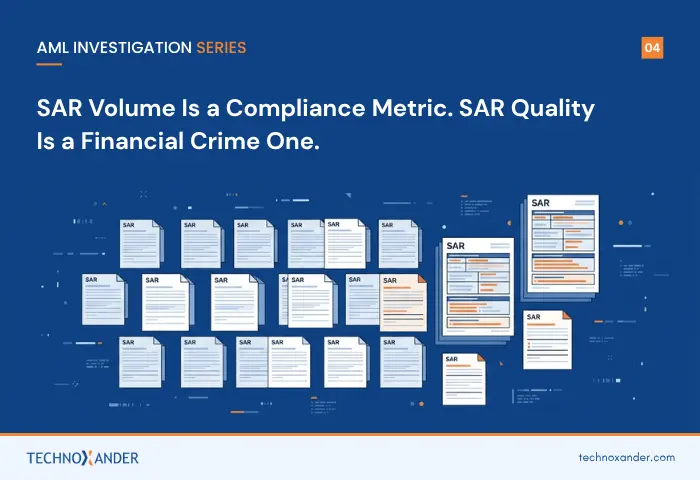
The NCA received 866,616 Suspicious Activity Reports in 2024/25, a slight decrease from 872,048 the year before, and volume has stayed close to record highs for several years running. But the NCA cannot act on most of what it receives. Not because the underlying suspicion was wrong. Because the SAR did not give it enough to work with: missing account numbers, incomplete timelines, or a narrative that describes what happened without explaining why it mattered. The receiving authority differs by market, FinCEN in the US, national financial intelligence units across the EU and the Middle East, but the same test applies everywhere: a filing that describes an event without explaining why it matters is compliant, not useful.
866,616 SARs were filed with the NCA in 2024/25. Not all of them were useful.
Most compliance teams measure whether SARs were filed. Very few measure whether the SARs they filed were any use to anyone.
What the NCA Actually Needs From a SAR
A useful SAR is timely, accurate, complete and concise. It identifies who is suspected, what triggered the suspicion, why that is suspicious given the customer’s known profile, and what evidence supports it. That last element, why in context, is where the quality gap most commonly appears. An analyst without automatic access to prior case history and risk trajectory can describe what happened, but not explain why it matters.
The result is a SAR that says: unusual cash deposits observed, inconsistent with account type. What the NCA needs is closer to: cash deposits of £9,600 to £9,800 across six months, following dormancy consistent with mule account activation, with counterparty payments to three previously flagged accounts.
The first version is filed. The second version is useful.
At a Glance: Weak SAR Narrative vs. Strong SAR Narrative
| Dimension | Weak narrative | Strong narrative |
|---|---|---|
| What it says | “Unusual cash deposits observed, inconsistent with account type.” | “Cash deposits of £9,600 to £9,800 across six months, following dormancy consistent with mule account activation, with counterparty payments to three previously flagged accounts.” |
| What’s missing | Amounts, pattern, timeframe, connections | Nothing. It is self-contained |
| Can the NCA act on it? | Not easily | Yes |
| Where it comes from | An analyst working from a partial picture | An analyst with full context at the point of investigation |
What a Good SAR Actually Looks Like
What makes a good SAR under NCA guidance?
A good SAR is timely, accurate, complete and concise. It identifies who is suspected, what activity triggered the suspicion, why that activity is suspicious in the context of the customer’s known profile, and what supporting evidence exists, in language specific enough for the NCA to act on. It is not a longer SAR. It answers a specific, recognisable set of questions every time, regardless of who wrote it.
| Element | What a good SAR does |
|---|---|
| The 5 Ws and how | Names who, what, when, where, why and how, in plain terms |
| Specificity | States amounts, dates, patterns and counterparties instead of general phrases |
| Data accuracy | Every key field populated and checked against the source system |
| Explaining suspicion | States the suspicion plainly and names the predicate offence it points to |
| Case-specific narrative | Written from that case’s own facts, not a reused template |
| Concise evidence | Leads with the suspicion and includes only the evidence that supports it |
A SAR is not judged on how much was written. It is judged on how little the reader has to guess.
Where Poor SAR Quality Originates
Why do so many SARs lack sufficient detail?
SAR quality is downstream of AML investigation quality. When an investigator spends most of their time assembling basic customer intelligence from separate systems, pulling records, searching for prior case notes, reconstructing timelines in a spreadsheet, the narrative they write reflects that process: compressed, covering only what they had time to check. This is a workflow problem, not an analyst capability problem.
JMLSG Part II guidance is clear that a SAR should set out the specific facts and circumstances behind the suspicion, which requires the investigator to have had access to those facts during the investigation, not reconstructed them from memory afterward.
A SAR that cannot explain suspicion in context is not intelligence. It is paperwork.
What Better Investigation Infrastructure Produces
The firms that consistently produce higher-quality SARs share one characteristic: their investigators have complete customer intelligence at the point of investigation, not assembled retrospectively once time pressure has mounted.
Does AI-assisted SAR drafting improve SAR quality on its own?
Not by itself. An AI tool that drafts a SAR narrative from incomplete investigation data produces an incomplete SAR faster. The quality improvement has to come from the investigation layer, meaning the context available to the analyst, not from the drafting step alone. AI-assisted narrative drafting adds genuine value only as a downstream benefit of a well-structured investigation, which makes this an investigation infrastructure decision, and increasingly, an AML investigation software decision.
At TechnoXander, our AI-powered AML Investigation Intelligence platform surfaces the customer context, prior case history and entity connections investigators need at the point of investigation, and generates a first-draft SAR narrative grounded in that same context, for the analyst to review, edit and take ownership of. It works alongside your existing transaction monitoring and AML case management system rather than replacing it, and supports SAR preparation for analysts and MLRO reviewers alike. Speak to our team to see how it works in practice.
About Author: