What is the missing layer in the AML technology stack?
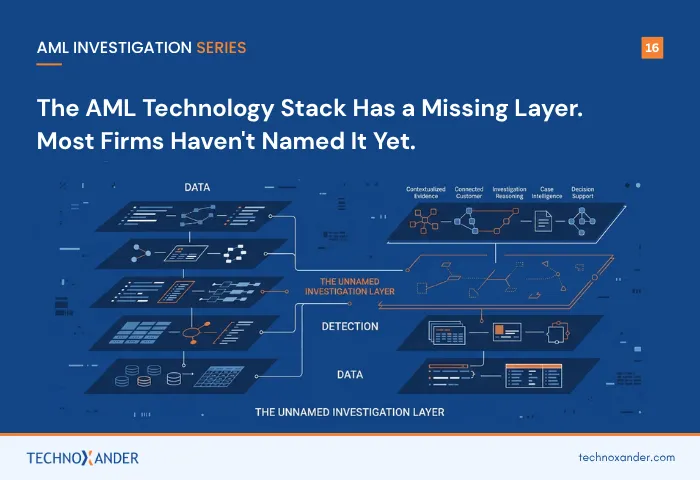
It is investigation intelligence: the technology layer that sits between detection (transaction monitoring, which generates alerts) and record management (case management, which stores dispositions). Almost every regulated firm has invested in the two ends of that stack. The middle, where an investigator actually assembles context and forms a view, is still running on manual effort.
Most AML technology investment in regulated financial institutions is concentrated at the extremes of the compliance workflow: detection engines at one end, case management systems at the other. The space in between, where investigators actually do the work that determines compliance outcomes, has been left almost entirely to manual effort.
That is not an accident. It is a structural blind spot that has compounded for years without being clearly named. The AML technology stack has two mature layers and one missing one, and the missing layer is the only one where a compliance decision actually gets made.
Why did detection and case management get funded before the investigation layer?
Because their outputs are easy to demonstrate. Alert volumes and false-positive reduction are measurable, and an audit trail either exists or it does not. Investigation quality is real but harder to demo. It shows up in SAR defensibility and analyst ramp-up time, outcomes that compound over time rather than producing an instant metric.
Mapping the Three-Layer Stack
Layer one is detection. Transaction monitoring systems, rules-based engines increasingly augmented by machine learning, analyse payment flows, generate alerts, and route flagged items for review. This layer has received significant investment for over a decade. Industry benchmarking research consistently finds that transaction monitoring remains the highest-spend category in AML technology budgets across regulated firms globally. The market is mature and the tooling is sophisticated.
Layer three is record management. Case management systems capture alert dispositions, store SAR filings, record audit trails, and provide the regulatory evidentiary layer. This layer is also well-developed. Most mid-sized regulated firms have a functioning case management system, and many have had one for years.
Layer two, the investigation layer, largely does not exist as a technology layer. It exists as analyst effort: retrieving customer context from multiple systems, assembling transaction histories, surfacing prior case reasoning, identifying relevant typologies, and forming a view on whether behaviour warrants escalation. Every regulated firm does this work. Almost none have purpose-built technology for it.
What the gap looks like in practice: An investigator opens an alert in their monitoring platform. To get the full customer picture, they open the core banking system in a separate tab, navigate to CDD records in a third application, search prior cases manually in the case management system, and consult a typology library, if one exists, held in a shared document or internal wiki. The investigation has not yet started. The retrieval has. That retrieval overhead is the investigation layer operating without infrastructure.
The Three-Layer AML Technology Stack
| Layer | Function | Investment level | Technology maturity |
|---|---|---|---|
| Detection | Generate alerts from payment flows | High, over a decade of spend | Mature, sophisticated tooling |
| Investigation | Assemble context, reason, decide | Minimal | Largely manual, analyst-dependent |
| Record management | Store dispositions, SARs, audit trails | High | Mature, well-established |
What the Investigation Layer Actually Consists Of
Investigation intelligence infrastructure has specific, nameable components. Context aggregation is the automatic assembly of the full customer picture, transaction history, CDD data, risk rating trajectory, counterparty relationships, prior case records, at the point of alert open, without manual retrieval across systems. This eliminates the context friction that forces investigators to spend the first portion of every investigation window gathering information that should already be in front of them.
Typology surfacing is the identification and presentation of relevant financial crime typologies based on the specific behaviour pattern under review, drawn from FATF typology guidance, JMLSG Part I and II guidance, and the institution’s own prior cases. Typology awareness should not depend on how long an analyst has been in the role.
Is the investigation layer just a case management feature?
No. Case management records what was decided. Investigation intelligence is what happens before that: assembling context, surfacing institutional memory, and generating structured analysis so the decision is well-reasoned in the first place. A case management system with no investigation layer in front of it still leaves that work to manual effort.
Institutional memory is the ability to surface prior investigation reasoning, not just prior case outcomes, when a new case shares characteristics with historical ones. The NCA SARs Annual Report 2025 consistently highlights that SAR intelligence value is higher when filings reflect an investigator’s understanding of behavioural context, not just transactional fact. That understanding needs to be embedded in the workflow, not locked in individual memory.
Stats callout: Industry compliance cost research found that investigation-related operational costs represent the largest share of AML compliance spend in financial institutions, yet investment in investigation infrastructure as a distinct technology layer remains disproportionately low relative to detection and case management tooling.
Where the ROI Actually Lives
Detection engines decide which activity gets flagged. Case management systems record what was decided. The investigation layer is where the decision is actually made: what the customer’s behaviour means, whether it warrants concern, and what the firm’s response should be. That decision is the compliance act.
The FCA’s Financial Crime Guide frames firms’ obligations in terms of the adequacy and effectiveness of their systems and controls, and equivalent US, EU, and Middle East frameworks apply the same effectiveness test. A transaction monitoring system that generates alerts accurately and a case management system that records outcomes reliably can both be performing well while investigations in between them are shallow, inconsistent, and inadequately documented. The regulatory risk does not live in the detection layer. It lives in the quality of what happens next. FCA examination of AML programmes increasingly focuses on the investigative process, not just the existence of monitoring rules and case records. The question has shifted from “do you have controls?” to “do those controls produce good decisions?”
The Missing Layer Has a Name Now
Naming the investigation layer as a distinct technology requirement is the first step to filling it. Firms that have invested in detection and case management have built two-thirds of an AML technology stack. The third layer is not an incremental feature of either of the other two. It is a discrete function, with specific infrastructure requirements, that sits between them and determines whether the compliance programme produces outcomes that hold up, in any regulated market.
At TechnoXander, our AML Investigation Intelligence Platform is built specifically for this layer, aggregating context, surfacing institutional memory, and generating traceable investigative rationale so investigators spend their time on decisions, not retrieval. Speak to our team to see the missing layer mapped against your current technology stack.
About Author: