What is an AML false positive?
An AML false positive is an alert that a transaction monitoring system flags as potentially suspicious but that an investigation confirms is legitimate activity. Industry conversion rates put the share of alerts that become a SAR at roughly 1% to 5%, meaning the large majority of alerts a compliance team reviews end in no escalation at all.
Picture a Monday morning in a financial crime compliance team. The alert queue has 340 unreviewed cases. Analysts worked through the weekend and closed 190. Overnight, another 280 alerts arrived.
The team is not falling behind because they are slow. They are falling behind because the system they depend on generates far more noise than signal, and less attention has gone to what happens after an alert is created than to generating the alert in the first place. That is where AML alert fatigue starts to become an investigation problem rather than simply an alert-volume problem.
Why AML False Positives Keep Rising
The NCA SARs Annual Report 2024/25 recorded 866,616 Suspicious Activity Reports in the UK, a slight decrease from 872,048 the year before. Industry estimates commonly put alert-to-SAR conversion rates at around 1% to 5%, so the overwhelming majority of alerts an AML monitoring system generates do not ultimately result in a SAR. The reporting regime differs by market, but the same pattern shows up wherever transaction monitoring generates alerts faster than investigation teams can resolve them, from US institutions filing SARs with FinCEN to EU and Middle East firms reporting under their own regimes.
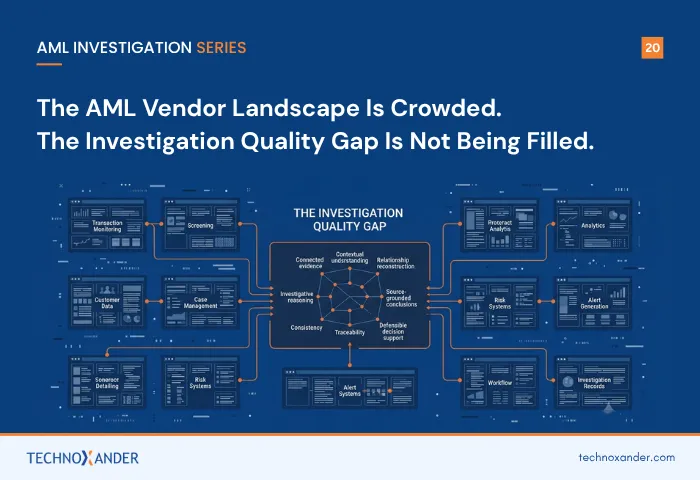
Most banks did not scale investigations. They scaled alert generation.
Is reducing false positives just a matter of tuning detection rules better?
Not on its own. Tuning can reduce how many alerts fire, but the alerts that remain still need an investigator to assemble context before anyone can judge whether they’re genuine. A quieter alert queue is not the same as a faster or more accurate one. The fix has to reach the AML investigation workflow, not only the detection step.
The Industry Scaled Alert Generation, Not Investigations
Most AML transaction monitoring systems in use today were built around rule thresholds: a transaction exceeds a certain amount, crosses a certain country, or fits a certain frequency pattern, and an alert fires. These rules were designed to be conservative, and reasonably so. The FCA Financial Crime Guide recognises that more sophisticated approaches, including machine learning, can provide a more rounded view of customer behaviour than rule thresholds alone, and JMLSG guidance gives firms a framework for applying AML and CTF requirements to their own business, products and customers.
The problem is that the customer base has changed. Regulated payment firms increasingly serve gig economy workers, freelancers, cross-border contractors and marketplace sellers, whose transaction patterns can look anomalous against legacy benchmarks while being entirely legitimate. A cross-border customer receiving frequent inbound EUR payments from multiple European counterparties may trigger velocity rules and geographic risk flags, when in reality that customer is a freelancer working for several European clients at once. The rules are not necessarily wrong. They simply do not have enough customer context context to know what the behaviour means.
What the Rules Engine Sees vs. What the Investigator Actually Needs to Know
| Transaction Pattern | What the rules engine flags | What determines if it’s genuine |
|---|---|---|
| Cross-border freelancer payments | Velocity and geographic risk rules fire | Onboarding profile, client type, payment history |
| Dormant account reactivation | Behavioural anomaly score rises | Prior dispositions, context for the gap |
| Round-number transfers | Structuring-pattern rule fires | Business type, invoice history, counterparty relationship |
Many AML teams are running today’s payment volumes through detection logic designed for a different banking environment.
How Alert Fatigue Impacts AML Investigations
Alert fatigue is well documented in financial crime compliance, but its real cost is rarely discussed clearly. The problem is not the size of the queue. It is the investigation time consumed by cases that ultimately require no escalation: the analyst still has to open the alert, understand why it fired, review the customer and transaction information, search for relevant history, and document the decision.
Why do false positives cost more than the SARs that actually get filed?
Because every alert, escalated or not, consumes roughly the same investigation effort up front. An analyst cannot tell a false positive from a genuine one without first assembling the customer’s context, so the alerts that turn out to be nothing cost the team almost as much time as the few that don’t.
The Real Problem: Investigators Spend More Time Assembling Context Than Analysing Risk
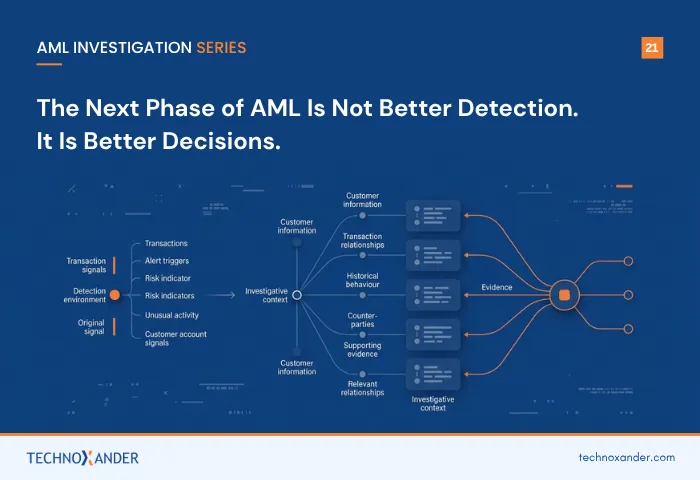
When an analyst opens an alert, they typically see a transaction, an account identifier and a rule name. What they do not automatically see is the customer’s prior SAR history, their full payment network, their onboarding risk rating, their entity connections, or how similar cases were resolved before.
So the analyst opens a second system for account history, a third for prior case notes, a fourth for onboarding data. They write information manually into a case record, rebuild a customer timeline from scratch, write a narrative, and close the case, only to repeat the process on the next alert in the queue. Every investigation starts almost from nothing, and each one discards the organisational memory in AML built in the one before.
This is context friction: the structural problem behind much of the alert fatigue financial crime teams experience. The information usually already exists inside the organisation. The investigator simply has to find it again, every time.
How AI Can Reduce AML Investigation Time
Addressing this means rethinking what an investigation looks like at the point of alert, not just adjusting thresholds or adding headcount. A more effective AML investigation workflow can surface related entities automatically, aggregate customer history and prior case dispositions into a single view, and generate a first-draft case narrative using RAG-powered AML investigation so investigators are editing rather than writing from a blank screen. It can also propose a disposition, close or escalate, with a confidence indicator grounded in how similar alerts were resolved before, for the analyst to accept or override. The investigator remains responsible for the decision; the technology gives them a more complete picture, and a starting judgement, to work from.
Does AI investigation software risk waving through a genuine case as a false positive?
No. The analyst reviews and can override every proposed disposition; the system never closes or escalates a case on its own. What changes is how much verified context is available before that judgement is made, not who makes it.
The Future of Financial Crime Operations
The next generation of financial crime programmes will not be defined solely by their ability to generate alerts. It will increasingly depend on the future of AML investigation: how effectively firms turn alerts into well-supported decisions. The FCA Financial Crime Guide makes the same broader point: firms need to understand the capabilities and limitations of their monitoring systems and ensure monitoring reflects the risks of their actual business and customer base.
The real problem facing financial crime teams is not always alert volume. It is the time spent searching for information that already exists.
At TechnoXander, we help regulated firms reduce investigation friction through our AI-powered AML Investigation Intelligence platform.
Speak to our team to see how it works in practice.
About Author: