What is customer-first AML investigation?
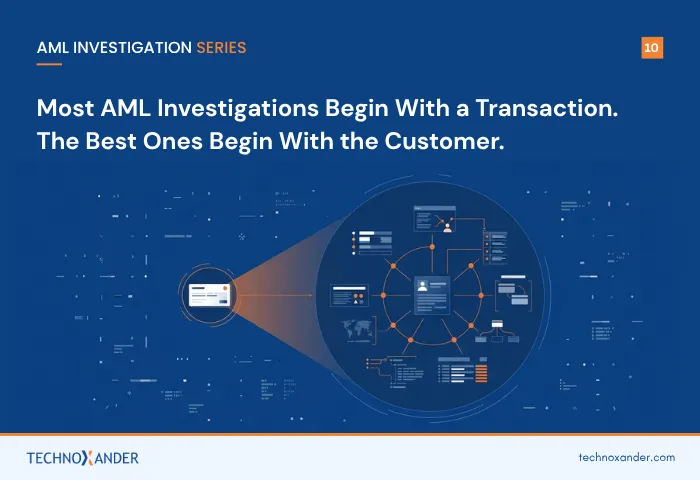
Customer-first AML investigation is a workflow where the system assembles a customer’s full history, prior cases, entity connections and typology context before the analyst opens the alert, so the first thing they see is the customer, not just the flagged transaction. It replaces the default sequence, where the analyst starts from a transaction and has to work backwards to understand who made it.
Transaction monitoring was designed to spot anomalous payments. It was not designed to understand the customer behind them. That design assumption, transaction first, customer context assembled later, shapes the entire investigation experience that follows. The analyst opens an alert and sees a payment, then spends most of the investigation window working backwards to understand the person or entity who made it. By the time they have enough context to decide, they have already used up the bulk of the time budgeted for the case.
Is checking whether a transaction is anomalous the same as assessing customer risk?
No, and most investigation workflows only answer the first question at the point an alert opens. Whether a transaction crossed a threshold and whether this customer represents genuine risk are different questions. Transaction monitoring answers the first; AML investigation answers the second, and it needs the customer’s full context to do it.
The Anatomy of a Transaction-First Investigation
A standard alert opens with a flagged transaction, a rule name and an account identifier. What follows is a retrieval sequence: transaction history to understand the payment pattern, the KYC file to understand the customer profile, the case management system to check for prior investigations, and the entity relationship view to identify connected accounts. Each step means switching systems and copying identifiers, and each one takes time spent on retrieval, not analysis.
In a moderately complex case, a customer with prior alerts, related accounts and a non-standard onboarding profile, this retrieval sequence can absorb most of the investigation window. The analyst reaches a decision eventually, but at the end of a process that was mostly assembly, not reasoning. That is an architecture problem, not a training one: most AML systems hand the investigator a transaction and expect them to build a customer story from it.
Transaction-First vs. Customer-First Investigation
| Dimension | Transaction-first (default) | Customer-first |
|---|---|---|
| What the analyst sees first | A flagged payment and a rule name | The customer’s full history, alongside the flagged payment |
| Prior cases and entity connections | Retrieved manually, if there’s time | Already surfaced |
| Where investigation time goes | Mostly retrieval | Mostly reasoning |
Why can’t analysts just assemble the full customer picture themselves before deciding?
Not because they lack the skill, but because the data lives across systems that were not built to work together at investigation speed. Manually reconstructing a complete customer picture for every alert, inside a routine triage window, is a structural constraint, not a training gap.
What Customer-First Investigation Actually Looks Like
A customer-first investigation workflow begins the moment the alert fires. Before the analyst opens the case, the system has already assembled the customer’s transaction history for the relevant period, their risk rating trajectory, all prior case records with disposition notes, entity connections across related accounts, counterparty risk indicators, and the typology context relevant to the flagged behaviour.
The analyst opens the alert and sees a customer, not a transaction. The flagged payment sits within a picture that already includes everything the institution holds about this individual or entity: the prior investigation from fourteen months ago, closed as consistent with documented income; the two related accounts showing correlated inflow patterns; the onboarding note explaining a cross-border payment structure. The analyst is reviewing an investigation that has already been substantially assembled, not starting one from nothing.
The Three Outcomes That Follow
Investigation quality improves at triage. When the alert view includes full customer context, non-suspicious cases become identifiable faster and with more confidence, and cases needing escalation are more clearly distinguished from those that don’t.
SAR narratives reflect the actual customer story. A SAR written with full customer intelligence assembled can explain why a behaviour is suspicious in context, how it fits the customer’s pattern over time, and what makes this instance different from prior alerts that were closed. That is the level of detail the NCA needs to act on a filing, and the level that builds a defensible record under FCA scrutiny.
Consistency improves across the team. When the customer picture is assembled systematically rather than manually, investigation quality depends less on which analyst handles the case and how much time they had. Two investigators reviewing the same customer at different times see the same assembled picture, which is what JMLSG Part I guidance expects and what supervisors look for in a well-governed programme.
Does customer-first investigation change who makes the final decision?
No. The system assembles the picture; the analyst still decides whether the behaviour is genuinely suspicious. What changes is how complete that picture is when the decision gets made, not who makes it.
Why This Is an Architecture Decision, Not a Process One
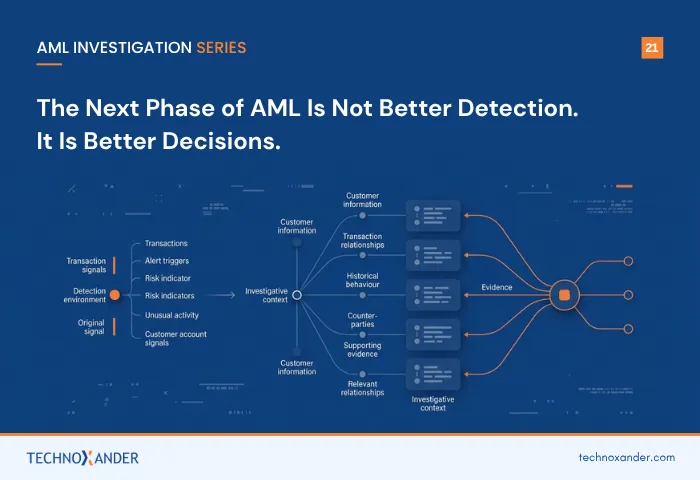
The shift from transaction-first to customer-first investigation isn’t achieved by changing analyst behaviour or updating procedures. It requires an investigation layer that aggregates proactively: pulling customer history, surfacing prior cases, connecting entity relationships, and applying typology context automatically, before the analyst opens the case, not after.
Financial institutions that have deployed AI investigation tooling have reported materially faster case triage and improved SAR quality, driven by changes in what investigators see at the point of alert, not by detection improvements alone. For regulated firms in the UK, US, EU or Middle East, the question worth asking is not whether alert generation is working. It is whether the investigation that follows gives analysts a fair chance to make a good decision.
At TechnoXander, our AML Investigation Intelligence Platform is built around the customer-first investigation model, assembling the complete picture before the analyst opens a case so their time is spent on decisions, not data retrieval. Speak to our team to see what the investigation experience looks like in practice.
About Author: