What is the hidden cost of manual AML investigation?
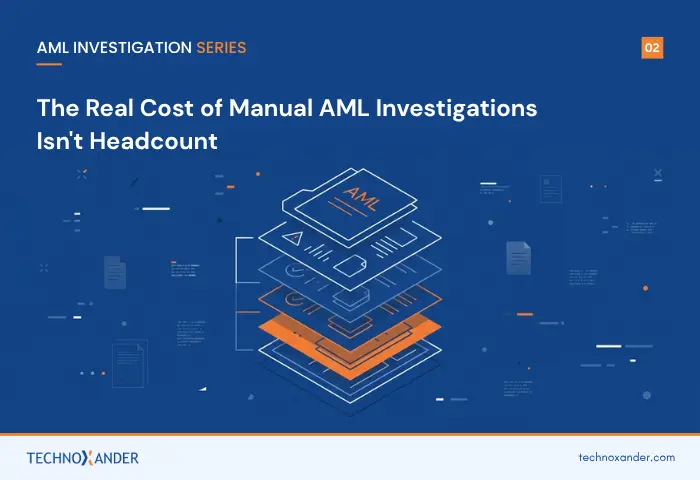
The hidden cost is the analyst time spent reassembling context an institution already holds: pulling account history from one system, prior case notes from another, and onboarding data from a third, for every alert, regardless of whether it turns out to be genuine. It shows up as investigation hours, rework and regulatory exposure, not as a single line item any budget tracks directly.
An analyst opens an alert. The AML detection system flags a payment. It tells them nothing else.
So the analyst opens a second tab for transaction history, a third for account notes, a fourth for the KYC file, a fifth for the group’s own AML policy on this customer type. They export data to a spreadsheet to compare patterns across dates. They search a case management system using a customer ID copied from somewhere else. They find a prior investigation, closed fourteen months ago, buried in a notes field with no structured tagging, and rekey that context into the current case record. They write a narrative from scratch that covers information a colleague already wrote up over a year ago.
Forty-five minutes later, the alert is closed as non-suspicious.
The biggest AML investigation cost is not escalation. It is repeatedly rebuilding AML investigation context the institution already has.
Why Hiring More Analysts Does Not Fix the Economics
When alert volumes rise, the instinctive response is to add headcount. It is also the least efficient one. More analysts running the same fragmented workflow at the same per-case cost does not reduce the unit cost of investigation. It scales the problem. A team of twelve doing the same manual data assembly that a team of eight was doing is not a more effective compliance programme. It is a more expensive one.
Does adding analysts reduce the cost per case?
No. Cost per case is set by the workflow, not the headcount. Industry benchmarking consistently shows that manual workloads remain the leading AML/KYC challenge for most banks, with the majority still relying on manual intervention for more than half of their AML/KYC processes, and cost-per-case has shown no material improvement at regulated institutions in the UK or elsewhere despite sustained hiring.
Investigators often spend more time navigating systems than evaluating behaviour. That is the cost nobody puts in the budget, and the one that compounds most aggressively as transaction volumes grow.
The Three Layers of Hidden Cost
Direct cost: people and investigation hours. Analyst salary, management oversight and technology access fees per case closed are visible in the headcount line, but rarely broken down to cost-per-case, which is where the real exposure becomes clear. At 8,000 alerts a month with a 95% false positive rate, over 7,600 cases will be closed as non-suspicious. At 40 minutes average per case, that is roughly 5,000 analyst-hours a month spent confirming that nothing was wrong.
Indirect cost: rework, escalations and QA loops. Cases that need additional system checks. SAR narratives redrafted when prior context was missed the first time. Senior analyst and MLRO review time on borderline cases where the original investigation lacked full customer history. SAR quality depends directly on the context available at the point of writing, and that quality gap originates upstream, in investigations that started without adequate context, not in analysts who were insufficiently skilled.
Invisible cost: regulatory exposure from processes that do not scale. This is the most consequential layer. In December 2025, the FCA fined Nationwide £44 million for inadequate AML systems and controls, finding that it had failed to maintain up-to-date due diligence on personal current account customers and had failed to identify customers using those accounts for undisclosed business activity, leaving that risk unmanaged for years. The finding was not that Nationwide lacked a compliance process. It was that the process had not kept pace with the complexity of its customer base. The UK is not unique in applying this test: FinCEN in the US, national regulators across the EU, and central banks in the Middle East scrutinise investigation processes on the same basis, whether they scaled with the business, not just whether they existed on paper.
The Three Layers, at a Glance
| Layer | What it looks like | Where it originates |
|---|---|---|
| Direct | Analyst hours spent assembling and rekeying context | Fragmented systems, no automatic aggregation |
| Indirect | Rework, redrafted SARs, MLRO review loops | Context missing at the point the analyst first wrote the case |
| Invisible | Regulatory findings when controls don’t keep pace with scale | A workflow that never adapted as volumes and customer complexity grew |
Why does the invisible cost matter more than the direct one?
Because it is the one that surfaces years later, at the moment of least control: in an FCA enforcement finding rather than a budget line. A firm can absorb rising analyst hours for years without anyone questioning the workflow behind them, but a supervisory finding that controls failed to keep pace turns that same workflow into a fine.
What Investigation Friction Actually Looks Like Day to Day
The term “manual process” understates what is actually happening. In practice, an analyst investigating a moderately complex alert will switch between four to six separate systems during a single case: copying and pasting identifiers between applications, exporting transaction data to a spreadsheet to run date-range comparisons the AML case management system cannot perform natively, and searching for related accounts in a customer database that was not designed for investigation workflows. They will also check, separately, whether the FCA has issued a relevant Dear CEO letter, what JMLSG or the Financial Crime Guide says about this typology, and what the group’s own AML policy requires, none of which lives inside the case management system. Each of those steps is investigative drag. None of them is investigation.
Where Investigation Friction Can Be Reduced
The institutions that have materially changed their investigation economics are increasingly looking at the AML investigation AI business case beyond simple headcount savings. They have done so with an AML investigation software that changes what an investigator encounters the moment an alert opens: account history, related entities, prior case dispositions, typology indicators and customer risk evolution assembled automatically, with a proposed disposition and confidence indicator the analyst reviews and can accept or override.
Does AML investigation software decide whether to close or escalate a case?
No. It proposes a disposition and the reasoning behind it; the analyst still makes the call. The case-assembly overhead largely disappears, but the decision, and the accountability for it, stays with the investigator.
Institutions that have deployed context-aware AI investigation tooling consistently report materially lower false-positive escalation rates and significantly faster case triage, driven by changes in what investigators see at the point of alert rather than by detection improvements alone.
Reducing investigation friction, not adding investigators to a broken workflow, is where the economics of AML compliance can actually improve. At TechnoXander, that is precisely what our AI-powered AML Investigation Intelligence platform delivers, working alongside your existing transaction monitoring and AML case management system rather than replacing it. Speak to our team to see what reduced investigation friction looks like for your operation, or run your own numbers through our AML Investigation ROI and Savings Calculator.
Headcount was never the problem. What analysts do with their time is.
About Author: