What is AML alert context?
AML alert context is the customer and case information relevant to an alert that already exists somewhere in the institution but does not appear automatically when the alert is opened. It includes prior investigations, risk history, connected accounts, typology data and relevant regulatory guidance. Transaction monitoring generates the alert. It does not assemble this context, because that was never its job.
Many financial institutions, in the UK and in other regulated markets, have invested significantly in AI-enhanced transaction monitoring over the past five years. Alert volumes have come down at some firms. Detection, in many cases, is smarter than it was.
The investigation workflow that follows the alert often has not kept pace.
A £9,800 cash deposit flags in a regulated payment firm. The system fires an alert. Correctly so. But what the investigator sees when they open that case is still familiar: a transaction, a rule name, an account number. The customer’s six prior investigations, all closed as consistent with their documented cash-trading business, do not surface automatically. The two related accounts showing the same inflow pattern are not visible. The onboarding note explaining this behaviour sits in a separate system.
The analyst goes looking. Again.
That is the gap that has not closed. Detection got smarter. The investigation experience stayed fragmented.
That is not a detection failure. It is a context problem. And it affects investigations across the industry, regardless of how much has been spent on the detection layer.
Transaction Monitoring Was Built to Flag Transactions. Not to Understand Customers.
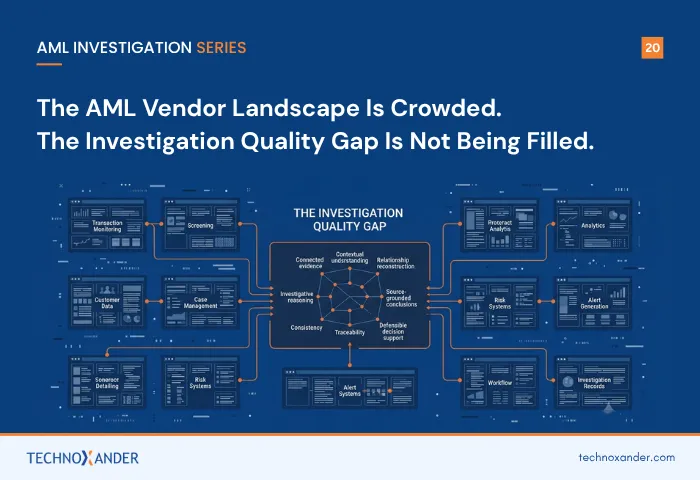
Transaction monitoring and AML detection are not the same thing, and the difference matters here. Transaction monitoring is the specific, rules-based system that checks transactions against defined thresholds and patterns and fires an alert when one is breached. AML detection is the broader category: transaction monitoring sits alongside sanctions and PEP screening, adverse media checks, and customer risk scoring. Transaction monitoring is one input into AML detection, not a synonym for it.
This is not a criticism of transaction monitoring technology. Rules-based systems do exactly what they were designed to do: identify transactions that match defined risk patterns and generate alerts for human review.
Is transaction monitoring the same as AML detection?
No. Transaction monitoring is one component of AML detection: a rules-based system that flags transactions matching defined risk patterns. AML detection is the broader term, and also covers sanctions and PEP screening, adverse media checks, and customer risk scoring. Transaction monitoring generates the alert. It does not assemble the customer context an investigator needs to act on it.
The design assumption was that human review would supply that context. An analyst would open the alert, pull the customer file, assess the broader picture, and make a judgement call. That model works when alert volumes are manageable and the information required for that judgement is easy to retrieve.
Neither of those conditions reliably holds in 2026.
Industry estimates commonly put alert-to-SAR conversion rates at around 1% to 5% across financial institutions. Most of what gets reviewed gets closed. But the review still happens, and each review requires the same context retrieval, the same system navigation, the same manual assembly of information the institution already holds.
Most transaction monitoring systems answer one question: did this transaction breach a rule? Almost none of them answer the question that actually matters: should I be worried about this customer?
What Is Missing at the Point of Alert
Why do AML alerts lack customer context?
Most transaction monitoring systems were designed to flag a transaction against a rule, not to present a complete customer picture. The context an analyst needs, such as prior case history, connected accounts and current regulatory guidance, typically sits in separate systems that are not linked to the alert. That gap is where AML investigation friction accumulates.
Customer risk history: the alert shows the flagged transaction. It rarely shows the customer’s risk rating trajectory: whether their risk score has moved over the past 12 months, what triggered previous reassessments, or whether their profile was escalated and de-escalated.
Prior investigation record: most AML case management systems hold prior case data, but it is not surfaced automatically. The analyst has to search for it, often using a customer identifier they have to copy from the alert into a separate system. If the prior case was logged under a slightly different reference, such as a maiden name, a trading name, or an account variant, it may not appear at all.
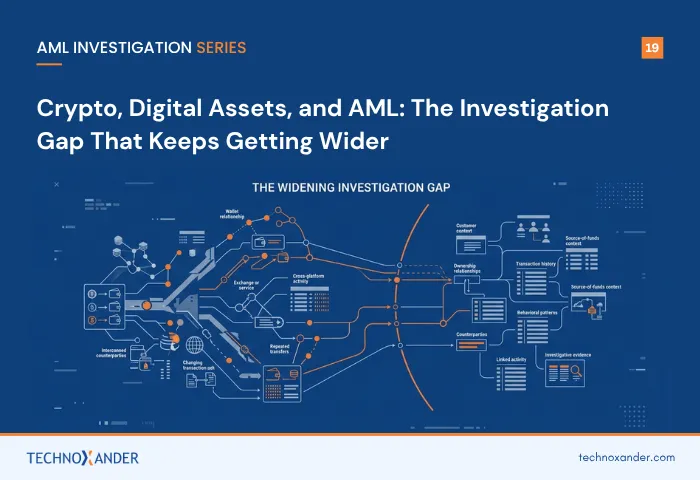
Related account and entity connections: the flagged account rarely exists in isolation. In mule network typologies, structuring cases, and trade-based money laundering, the risk is distributed across multiple accounts and counterparties. JMLSG Part II guidance explicitly requires firms to consider connected parties when assessing suspicious activity. But the connections are seldom visible in a standard alert view. The analyst has to go looking.
Typology context: a transaction that matches a structuring pattern means something different if it also matches the velocity profile of a mule account versus the seasonal pattern of a legitimate cash business. That typology layer is rarely connected to alert generation in a way that surfaces it usefully at the point of review.
Counterparty intelligence: where the money came from and where it went matters as much as the amount and timing. Counterparty risk is frequently assessed separately, if at all, rather than being integrated into the alert triage view.
Regulatory and policy signals: whether the FCA has issued a relevant Dear CEO letter on this typology, what JMLSG or the Financial Crime Guide currently says about it, and what the firm’s own AML policy requires are not linked to the alert either. The analyst has to know to go looking for each of these separately, and then go and find them.
At a Glance: What the Alert Shows vs What the Analyst Has to Find Manually
| Missing element | What the alert shows instead | What the analyst has to do |
|---|---|---|
| Customer risk history | The single flagged transaction | Search separately for risk score movement and past reassessments |
| Prior investigation record | Nothing, unless manually retrieved | Search the case management system, often under a different customer reference |
| Related account and entity connections | The one flagged account | Manually identify connected accounts and counterparties |
| Typology context | A rule name | Judge which typology the pattern actually fits, unaided |
| Counterparty intelligence | Amount and timing only | Assess counterparty risk separately, if at all |
| Regulatory and policy signals | Nothing | Check Dear CEO letters, JMLSG, the Financial Crime Guide and internal policy separately |
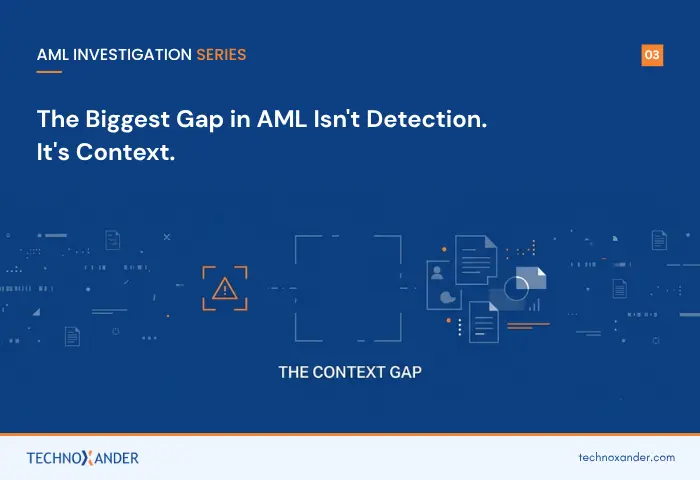
None of this information is missing from the institution. It is simply missing from the investigation moment.
The result is an analyst making a risk decision on a partial dataset, not because they are incapable, but because the system handed them an incomplete picture and expected them to fill the gaps manually. Many investigators are effectively making those judgements while looking through a keyhole.
Why This Matters More as Customer Bases Diversify
The context gap was manageable when institutions served relatively predictable customer populations. It has become a structural problem as EMIs, challenger banks, and payment platforms have grown customer bases that are far more varied: gig workers, international contractors , marketplace sellers, crypto users, small businesses with irregular income cycles.
For these customers, a transaction that looks anomalous against a generic benchmark may be entirely normal for their specific profile. The FCA’s Financial Crime Guide is explicit: risk assessments must be calibrated to the actual customer base, not to a generic model. Threshold rules designed for high-street retail banking, applied to an EMI serving cross-border freelancers, will produce alert volumes that bear little relationship to actual risk.
What Connecting the Picture Actually Changes
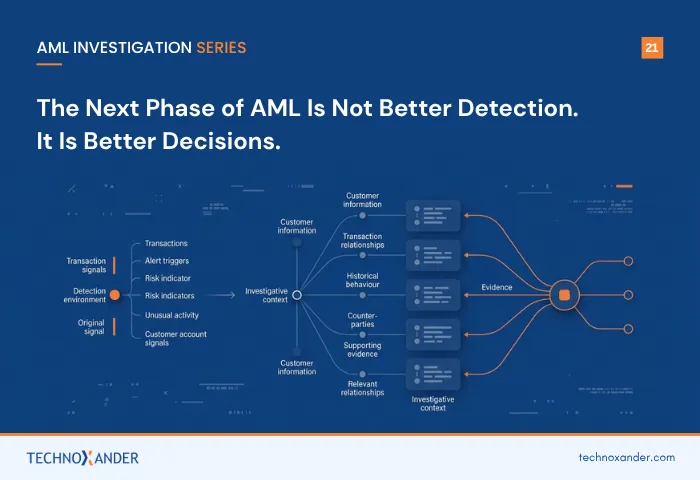
When an alert arrives with customer context already assembled, including risk history, prior case dispositions, entity connections, counterparty flags, and typology indicators, the investigation changes in character, not just in speed.
Assembling that picture is not the end point on its own. The more useful systems go a step further: proposing a disposition, close or escalate, with a confidence indicator behind it, so the analyst starts from a recommendation rather than a blank case. The analyst still reviews the evidence and makes the decision. They can accept the recommendation or override it, but they are no longer starting from zero on every case.
The analyst is no longer asking “where do I find what I need?” They are asking “given everything I can see, and what the system is recommending, does this hold up?” That is the question they were hired to answer. It is also the question that generates better SAR quality, better audit trails, and more defensible decisions for the MLRO under FCA scrutiny.
Financial institutions that have deployed AI investigation tooling have reported materially faster case triage and improved SAR quality. That improvement is driven by changes in what investigators see at the point of alert, not by detection improvements alone.
How can financial institutions close the AML context gap?
By assembling customer history, entity connections, typology indicators and regulatory guidance automatically at the point of alert, and by having the system propose a disposition the analyst can accept or override, rather than requiring the analyst to search for each element separately and start every case from a blank page.
Context is not a nice-to-have addition to the investigation workflow. For most financial institutions, it is the missing component that determines whether the workflow produces good outcomes or just high volumes.
For regulated EMIs and banks operating in increasingly complex customer environments, whether supervised by the FCA, FinCEN, an EU national regulator or a Middle East central bank, reducing context friction at the point of alert is where the next meaningful improvement in AML investigation quality will come from.
At TechnoXander, our AI-powered AML Investigation Intelligence platform is built around exactly this principle. It aggregates customer history, entity connections, typology indicators, and prior case intelligence into a single investigation view, and proposes a disposition, close or escalate, for the analyst to accept or override. It works alongside your existing transaction monitoring and AML case management system rather than replacing it, so analysts spend their time on decisions, not on data retrieval. It is built for banks, payment service providers, e-money institutions, professional services firms and other regulated organisations. Speak to our team to see how it works in practice.
If your analysts are making risk decisions on a partial picture, the fix is rarely more alerts or more headcount. It is giving them the picture, and a starting recommendation, they are already entitled to see.
About Author: