What makes cross-border AML investigation harder than domestic cases?
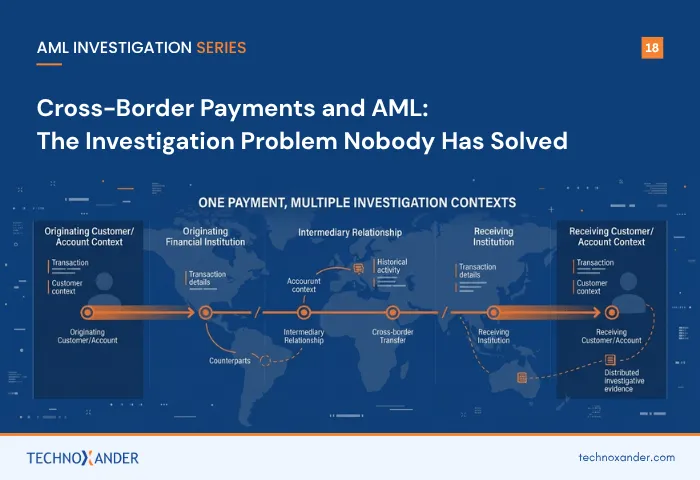
The information an investigator needs, counterparty jurisdiction risk, correspondent banking exposure, and behaviour benchmarked against the right peer group, is spread across more sources, systems, and jurisdictions than a domestic case. Detection triggers on cross-border activity readily. Investigation, which requires assembling that scattered picture, consistently falls short.
Cross-border payment volumes are growing faster than the AML investigation infrastructure that is supposed to assess them. That is not a technology problem. It is a design problem. Most AML investigation tools were built for domestic payment behaviour, not the multi-jurisdiction customer profiles, correspondent banking opacity, and typology complexity that cross-border cases require. Detection gets triggered. Investigation falls short. The gap between the alert that fires and the quality of the investigation that resolves it is widest in exactly the case type where it matters most, whether the investigating firm sits under UK, US, EU, or Middle East supervision.
Transaction monitoring was optimised for domestic behaviour benchmarks. When a customer profile is inherently cross-border, those benchmarks do not apply, and the investigator is left doing manually what the system should be doing structurally.
Why do cross-border alerts take longer to investigate than domestic ones?
Not because analysts lack skill. It is because the counterparty and jurisdiction context an investigator needs is rarely pre-assembled the way domestic context is. In a domestic case, the data usually sits inside the firm’s own environment. In a cross-border case, it typically does not, and the investigator pivots to manual external searches to build a picture the system has not built for them. This is one of the central cross-border AML investigation challenges UK firms face when customer and payment relationships span multiple jurisdictions.
Where the Investigation Friction Is Widest in Cross-Border Cases
Counterparty intelligence is fragmented. A payment firm investigating a cross-border alert needs to assess the counterparty on the other end, their jurisdiction, entity type, and exposure to high-risk financial crime environments. That data is frequently not accessible within the firm’s own environment, forcing manual searches to assemble a counterparty risk picture the system has not pre-assembled. This makes cross-border financial crime investigation materially more dependent on context retrieval.
Customer behaviour looks anomalous against domestic benchmarks. A contractor receiving frequent EUR inflows from multiple EU counterparties may trigger velocity rules calibrated for domestic salary patterns. A small importer paying multiple suppliers in one jurisdiction may trigger structuring rules built around domestic retail behaviour. Both may be entirely consistent with declared business activity, but the investigation layer has no built-in mechanism for benchmarking behaviour against the right cross-border peer group.
A concrete picture: An analyst opens an alert on a registered SME that processes payments to seven counterparties across four jurisdictions over a 30-day period. The rule fired on multi-beneficiary outflow velocity. The investigator needs to establish whether those jurisdictions represent elevated risk, whether payment terms match declared trade activity, whether the currency conversion pattern is consistent with legitimate trade or with layering, and whether any counterparty appears in prior case history. Under a standard workflow, assembling that picture means navigating external databases, checking sanctions and adverse media manually, and reviewing transaction history in a separate system, before any analysis has begun. The investigation window is largely consumed by retrieval.
Currency conversion patterns require typology context the system does not supply. Trade-based money laundering, layering through correspondent accounts, and structured cross-border transfers each present differently depending on the currency corridors, the timing of conversions relative to trade documentation, and beneficiary account patterns across jurisdictions. An investigator needs typology context for those variables, not a generic structuring alert with no cross-border framing.
The Typologies That Demand Better Cross-Border Investigation Infrastructure
Trade-based money laundering (TBML). FATF’s guidance on TBML identifies it as one of the most consistently under-detected and under-investigated financial crime methods, precisely because its indicators are spread across trade documentation, payment patterns, and counterparty networks rather than concentrated in a single transaction event. That context is rarely available to the investigator at the point of alert review.
Layering through correspondent accounts. JMLSG Part II guidance on correspondent banking frames correspondent relationships as a specific area of elevated risk because of the opacity they introduce into the payment chain. A payment arriving through a correspondent route may carry limited originator information, and assessing it properly is currently a research task under most workflows. It should be an investigation intelligence function.
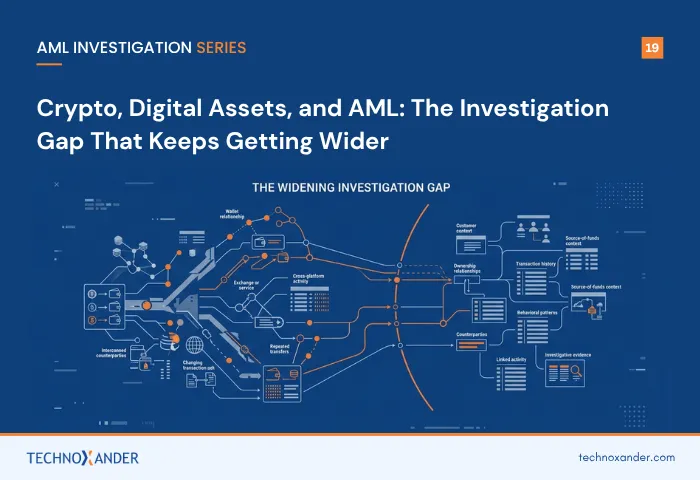
Crypto off-ramps. Cross-border payment flows that terminate in or originate from crypto conversion points present a specific challenge: the on-chain history may be visible, but connecting it to the fiat payment leg requires both typology intelligence and tooling most investigation platforms were not designed to provide. FATF’s updated guidance on virtual assets is explicit that VASP-adjacent payment flows require the same quality of investigation as traditional correspondent flows, a standard most current workflows are not equipped to meet for cross-border cases.
Does a crypto off-ramp make a cross-border case harder to investigate than a pure fiat one?
Usually, yes. The investigator needs to connect two separate evidentiary trails, the on-chain transaction history and the fiat payment leg it converts into, and most investigation platforms were not built to present both as one linked picture. Without that link, the crypto leg and the fiat leg get assessed in isolation, which is exactly where typology-relevant patterns get missed.
Cross-Border Typologies and the Infrastructure Gap Behind Each
| Typology | Where indicators are scattered | What investigation infrastructure should surface |
|---|---|---|
| Trade-based money laundering | Trade documentation, payment patterns, counterparty networks | Trade-layer context at the point of alert review |
| Correspondent layering | Intermediary institutions, originator information | Correspondent network risk profile, not a manual lookup |
| Crypto off-ramps | On-chain history vs. fiat payment leg | Connected view linking both legs with typology context |
Why Customer-First Investigation Changes Cross-Border Case Quality
The dominant workflow treats cross-border cases as transaction events with a jurisdiction variable: start with the alert, work outward to the customer, check the counterparty, assess the jurisdiction. That sequence is backwards. The investigation should start with the customer, their declared business model, expected payment geography, and prior case history, so that by the time the investigator reaches the transaction, they already have the context that determines whether the behaviour is anomalous or expected.
Industry benchmarking research is explicit that customer risk should drive investigation depth, not just alert parameters. For cross-border cases, that has a direct operational implication: the investigation layer needs to present the full customer picture, including cross-border payment history, counterparty geography, and prior disposition reasoning, before the investigator begins assessing the specific alert.
The investigation gap by numbers: according to the NCA SARs Annual Report 2025, SAR narrative quality remains an area of material concern, with filings frequently failing to provide sufficient contextual detail for law enforcement to act. Cross-border cases, where the investigative picture is most complex, are disproportionately represented in low-quality SAR filings, and equivalent financial intelligence units in the US, EU, and Middle East report the same pattern in their own filing quality reviews. The investigation gap is deepest where the customer profile is most complex.
What Closing the Cross-Border Investigation Gap Requires
It requires AML investigation infrastructure designed for multi-jurisdiction profiles, not domestic AML tools applied to cross-border cases by default. Specifically: counterparty risk intelligence assembled before the investigator opens the case, not sourced manually mid-investigation; typology context for cross-border patterns, TBML indicators, correspondent banking red flags, crypto off-ramp signatures, surfaced at the point of alert review rather than buried in a library the analyst has to find; and customer-first investigation views that present cross-border payment history, counterparty geography, and prior case reasoning as the starting point of the investigation, not the end state.
Cross-border case complexity is consistently among the top drivers of investigation time and cost in regulated financial institutions everywhere. The investment is going into detection improvements. The investigation experience, for the analyst sitting with a cross-border alert and a fragmented picture, has not kept pace. Detection got smarter. The cross-border AML investigation experience can still remain fragmented. That is the gap nobody has solved, and the one that matters most as cross-border payment volumes continue to grow.
At TechnoXander, our AML Investigation Intelligence Platform assembles multi-jurisdiction customer context, surfaces cross-border typology intelligence, and presents the full customer picture before the investigator makes their first decision. Speak to our team to see what cross-border investigation intelligence looks like in practice.
About Author: