What is the investigation quality gap in the AML vendor market?
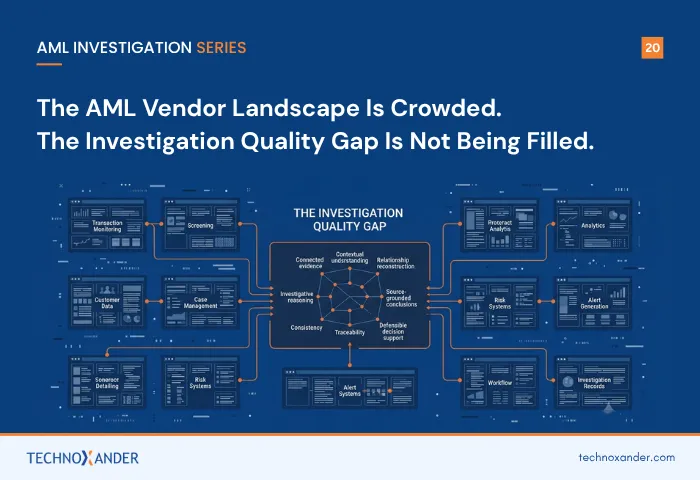
It is the space between what most AML vendors sell and where compliance outcomes are actually decided. Most vendors compete on detection, catching more risk signals, faster, with fewer false positives. Almost none compete on investigation quality, the assembled context, institutional memory, and traceable reasoning that determine whether the decision made on each alert would survive a regulator’s review.
The AML technology market has never had more options, more capability claims, or more vendor noise. It has also never been harder to identify what the actual compliance outcome gap is, and which vendors are seriously addressing it.
Here is the uncomfortable truth about that market: most AML vendors are competing for the same problem. They are competing on detection. And detection, for all its genuine importance, is not where the compliance outcome is determined, in any regulated market.
Is a better detection system the same thing as a better AML programme?
Not on its own. Detection decides what gets flagged. The compliance outcome, whether the resulting investigation is thorough, consistent, and defensible, is decided afterward, in a layer most vendors do not build for. A firm can have excellent detection and still fail supervisory scrutiny on the quality of what happens next.
How the Vendor Market Is Actually Structured
The AML technology stack maps broadly across three layers. Most vendor competition, and most procurement attention, is concentrated in the first two.
Detection is where transaction monitoring vendors, sanctions screening platforms, adverse media tools, and behavioural analytics systems compete. These platforms surface risk signals: flagged transactions, exposed entities, behaviour anomalies. The vendor market here is large, established, and genuinely competitive on capability.
Case management is where alerts are routed, assigned, tracked, and closed. Case management platforms provide the workflow infrastructure for moving alerts through disposition stages and producing audit logs. The tooling here is functional rather than investigatively intelligent: it manages the workflow but does not systematically improve the quality of the investigation happening inside it.
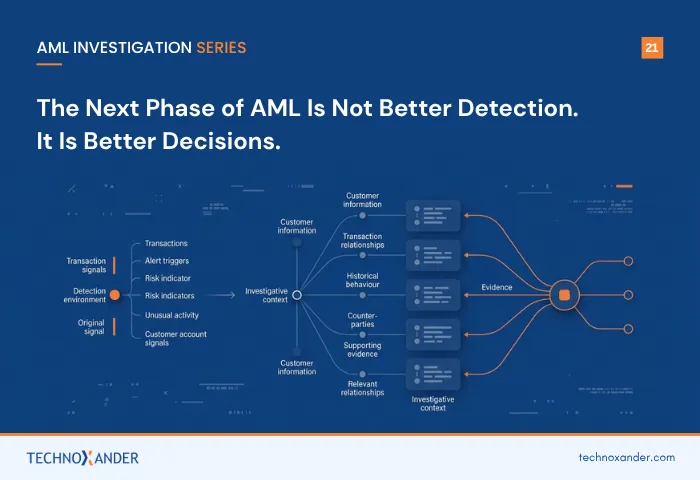
Investigation intelligence is the layer that supports the actual analytical work: assembling customer context at the point of alert, surfacing relevant institutional knowledge from prior cases, providing structured investigative analysis aligned to internal AML procedures, and generating traceable investigative rationale for every decision. This is where the compliance outcome, the quality of the decision and the defensibility of the reasoning, is actually produced. That third layer is where the fewest vendors compete and where the largest capability gap exists.
The Three-Layer Vendor Market
| Layer | What vendors sell | How crowded the market is | Where compliance risk actually sits |
|---|---|---|---|
| Detection | Alert generation, screening, analytics | Large, mature, highly competitive | Lower and falling as detection improves |
| Case management | Routing, tracking, disposition logging | Established, mostly functional parity | Neutral, records outcomes but doesn’t improve them |
| Investigation intelligence | Context assembly, institutional memory, rationale | Small, underdeveloped | Highest, and rising as detection improves faster than this layer |
Why Detection Attracts Most Vendor Competition
The clustering of vendor attention at the detection layer is not irrational. Detection capability is easier to demonstrate in a procurement process. Precision and recall metrics on a flagging model are quantifiable, comparable, and legible to a buying committee. A vendor can show, in a proof-of-concept, that its system catches more cases than a benchmark, and that is a compelling demonstration.
Investigation quality is harder to demonstrate on a short timeline. The benefits show up in decision consistency across a team, in SAR narrative quality that improves over months, in audit trail depth that holds under supervisory scrutiny, and in new investigator ramp-up time that compresses because institutional knowledge is surfaced in the workflow. These are real and significant, but they take longer to become visible, and they require the buying organisation to have a framework for evaluating them.
Industry benchmarking research notes that the gap between investment in detection infrastructure and investment in investigation quality infrastructure is one of the defining structural imbalances in the financial crime compliance technology market, in every jurisdiction this affects. Firms invest in the tooling that produces the alert. They under-invest in the tooling that determines what happens next, and regulatory exposure in AML is disproportionately associated with investigation quality failures, not detection model performance.
The “Best TM System” Framing Is the Wrong Frame
A substantial portion of AML technology procurement is still organised around a primary question: which transaction monitoring system should we use? That framing makes sense if the primary risk exposure is in detection gaps. For most regulated firms at current maturity levels, it is not.
Why is asking “which TM system is best” often the wrong procurement question?
Because for most firms at current maturity, detection is already generating adequate alert volume. The unresolved question is what happens to those alerts afterward, and a better detection system alone does not answer it. It can even make the underlying problem worse by generating more alerts for the same under-resourced investigation layer to process.
Detection capability at most regulated firms is generally adequate. Alerts are being generated. The question is what happens to them. If the investigation that follows is shallow, context-poor, and poorly documented, then better detection creates more of the same problem rather than improving compliance outcomes.
A concrete picture: A regulated firm runs a well-configured transaction monitoring system generating 800 alerts per month. Its investigation team closes 90% of those alerts as non-suspicious within 48 hours. From a detection standpoint, the system is working. But if each investigation is conducted with minimal customer context, because retrieving the full picture requires navigating three separate systems, and the reasoning behind each closure is recorded only as a disposition code, the firm has a detection layer it can defend and an investigation layer it cannot. When a regulator looks at case records, it is the investigation layer they examine.
The FCA’s Financial Crime Guide is clear that systems and controls must be effective, not just present, and equivalent US, EU, and Middle East supervisory frameworks apply the same substance test. A well-configured TM system with a weak investigation layer does not constitute effective controls anywhere.
An Evaluation Framework for Investigation Quality
Compliance leaders evaluating AML technology vendors should assess across five investigation quality dimensions: the same dimensions that distinguish a mature investigation programme from one that only appears mature.
Does the platform assemble the full customer picture, KYC, transaction history, risk rating trajectory, prior case records, before the investigator begins analysis, without navigation to separate systems? Does it surface reasoning from prior closed cases when investigators encounter similar profiles, or does every investigation begin from a blank slate? Does it provide investigation guidance aligned to the firm’s internal AML procedures, so the same analytical questions apply consistently to comparable cases? Does it support investigation narratives that are contextually specific and behaviourally grounded, aligned to NCA SAR reporting expectations? And does it capture traceable investigative rationale, the evidence assessed, the guidance applied, the contextual factors considered, for every decision, rather than just recording that one was made?
These questions reframe the procurement conversation from “which system catches more cases” to “which system produces better investigation decisions?” That is the right conversation, because the compliance outcome that matters is not the alert rate. It is the quality and defensibility of what happens after the alert. Firms that align AML technology procurement to investigation quality outcomes rather than detection benchmarks consistently demonstrate better regulatory standing over time.
The AML vendor landscape will continue to grow. Most of what is being added to it will be more sophisticated detection. The gap at the investigation quality layer will remain until compliance leaders make it a procurement priority.
At TechnoXander, our AML Investigation Intelligence Platform was built specifically for the investigation quality layer, the layer that determines whether a compliance programme can actually be defended. Speak to our team to see how it maps against your current investigation infrastructure.
About Author: