What is AML programme maturity?
AML programme maturity is not whether a firm has a risk appetite statement, a monitoring framework, and a SAR filing procedure. Almost every regulated firm has those. Maturity is whether the investigation happening between an alert and a disposition is actually good: complete, consistent, defensible, and traceable, regardless of which analyst handles the case or when.
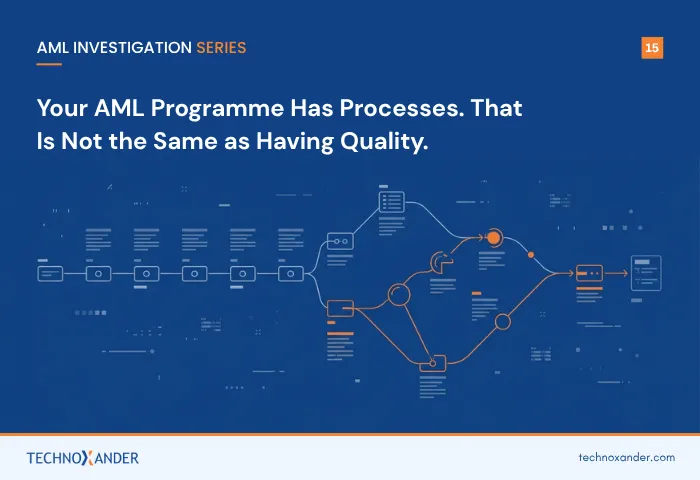
Most AML self-assessments ask whether a process exists. Almost none of them ask whether it works. There is a risk appetite statement. There is a transaction monitoring framework. Alerts are reviewed. SARs are filed. A training programme is in place. Mapped against a standard maturity framework, the programme looks complete.
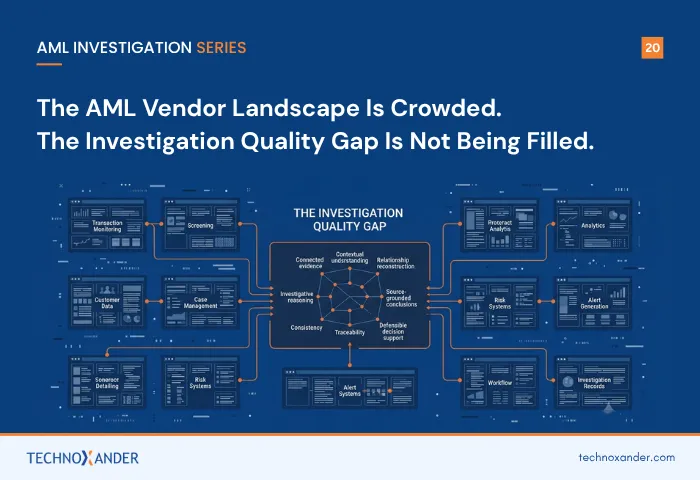
The question that standard frameworks rarely ask is what quality of investigation happens between alert and disposition. Not whether it happens. Whether it is good. That gap, between process existence and AML investigation quality, is where most AML programmes carry their actual risk, and it is almost entirely invisible until a regulator looks closely enough to find it.
Can a firm pass a maturity checklist and still have a weak AML programme?
Yes, routinely. A checklist measures whether components exist: a policy, a template, an escalation path. It does not measure whether the investigations those components produce are thorough, consistent, or actionable. Firms with fully documented programmes have still been fined for the quality of the AML controls and investigations underneath them.
Why Process Existence Is a Weak Proxy for Maturity
Process existence is easy to evidence and easy to confuse with capability. A firm can demonstrate a SAR filing procedure, a case template investigators follow, escalations routed to a named decision-maker. Each is a genuine compliance artefact. None tells you whether the investigations that produced the SARs were thorough, whether escalation decisions were consistent, or whether filing narratives gave the NCA enough to act on.
Industry benchmarking research draws a direct distinction between programme completeness, having the required components in place, and programme effectiveness, those components achieving their intended outcomes. Most internal self-assessments measure the former. Most regulatory reviews are concerned with the latter.
The FCA’s Financial Crime Guide frames this through the lens of outcomes: firms are expected not just to have systems and controls but to demonstrate those controls are working proportionately and effectively. US, EU, and Middle East supervisors apply the same substance-over-form logic in their own AML examinations, so a programme that is fully documented and comprehensively structured can still produce investigations that are shallow, inconsistent, and non-actionable, wherever it sits.
Genuine AML programme maturity looks different. It is visible across five specific dimensions.
The Five Maturity Dimensions
| Dimension | Weak signal | Strong signal |
|---|---|---|
| Investigative completeness | Context retrieved manually across systems | Full customer picture assembled before analysis begins |
| Decision consistency | Outcomes vary by which analyst opened the case | Comparable cases reach explainable, consistent conclusions |
| Institutional memory | Every new case starts from nothing | Prior reasoning is retrievable and surfaced automatically |
| SAR quality | Filings are complete but thin | Filings are specific, contextual, and actionable |
| Audit trail depth | A disposition code and a timestamp | Full reasoning, evidence, and typology reference per case |
Investigative Completeness and Decision Consistency
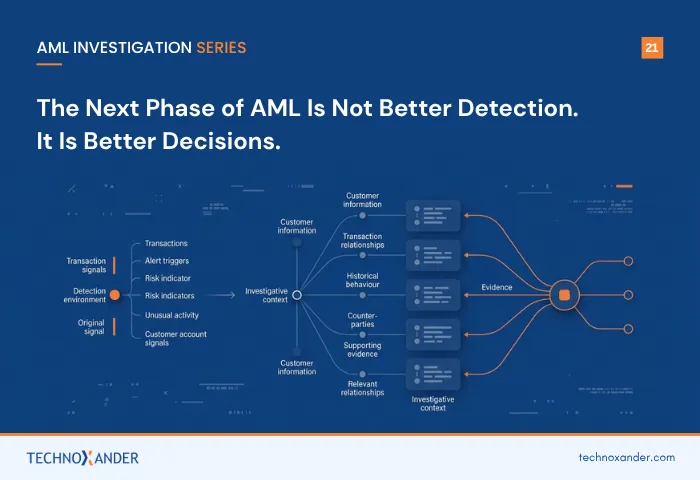
A mature AML investigation programme ensures the investigator has the full customer picture at the point of alert, not at the end of a retrieval sequence. The measure is not whether context exists somewhere in the system. It is whether it is assembled and presented before the investigator begins analysis.
Diagnostic question: If an investigator opens an alert right now, how long before they have the customer’s full transaction history, risk rating trajectory, and prior case records with disposition reasoning in front of them, without navigating to a separate system?
A mature programme also produces consistent decisions on similar cases, regardless of which investigator handles them. This is not about removing analyst judgement. It is about ensuring two investigators reviewing materially similar profiles reach conclusions explainable by the facts of those cases, not by which analyst happened to get the alert. JMLSG Part I guidance expects firms to apply risk-based assessments in a consistent, documented manner. Without surfaced institutional context and structured investigative analysis, consistency becomes a function of team experience rather than programme design. That is a fragility, not a capability.
Institutional Memory and SAR Quality
A mature AML investigation programme learns from every closed investigation. An immature one stores the outcome and discards the reasoning. When a senior analyst closes a complex case with documented reasoning, explaining why a payment pattern was consistent with a verified business model, that reasoning should be retrievable by the next investigator who encounters a similar pattern. In most AML environments, it is not.
A concrete picture: A regulated firm with four years of AML case history holds thousands of closed investigations across dozens of customer typologies. A new investigator joins and encounters an alert on a profile type the institution has handled thirty times. Without institutional memory surfaced in the workflow, that investigator starts from nothing. With it, they start from accumulated institutional experience. Neither difference shows up on a process maturity checklist.
Why does institutional memory matter more as an AML team grows?
Because growth means hiring, and new hires do not carry the pattern recognition experienced analysts accumulate. If that reasoning lives only in senior analysts’ heads rather than in the workflow, every new hire starts from blank, and consistency degrades exactly when the team is scaling fastest.
A mature programme also produces SARs that are actionable to law enforcement, not merely filed. The NCA SARs Annual Report 2025 has consistently highlighted that the intelligence value of SAR filings varies significantly, and that filings lacking contextual specificity and clear grounds for suspicion are of limited operational use regardless of their compliance value to the filer. SAR quality is a downstream indicator of investigation quality: a SAR written on the basis of a shallow investigation, assembled under time pressure from a partial picture, will reflect that shallowness.
Audit Trail Depth
A mature programme can defend every investigation decision under regulatory scrutiny. An immature one can show only that a decision was made. If a supervisor asks why a specific alert was closed non-suspicious eighteen months ago, can the firm demonstrate the context available to the investigator, the reasoning applied, the typology referenced, and what distinguished this case from cases that were escalated?
The FCA’s £44 million fine against Nationwide in December 2025 illustrates this failure mode directly. The FCA found that “Nationwide failed to get a proper grip of the financial crime risks lurking within its customer base. It took too long to address its flawed systems and weak controls, meaning red flags were missed with serious consequences.” The failure was not an absence of process. It was that the investigation operation could not surface, trace, and act on risk signals already present in the customer base. Traceable investigative rationale, where every case record captures the outcome, the evidence assessed, and the guidance applied, is what separates a programme that can be defended from one that can only be described.
Applying the Benchmark
These five dimensions are diagnostic lenses, not a scoring framework. A compliance leader asking honest questions about their programme should be able to characterise each one as either structurally embedded or dependent on individual effort. The ones dependent on individual effort are the ones that degrade under volume pressure, staff turnover, and supervisory scrutiny, whether that scrutiny comes from the FCA, a US federal examiner, or an EU or Middle East supervisor applying the equivalent standard.
One of the most consistent patterns in FCA enforcement is the gap between firms’ self-assessment of AML maturity and the regulator’s own assessment of the same programmes. The gap is not dishonesty. It is the difference between measuring whether a process exists and measuring whether investigation quality is actually good. The question worth asking is not whether your AML compliance programme passes a checklist. It is whether it would hold up if a regulator looked at the work.
At TechnoXander, our AML Investigation Intelligence Platform addresses all five maturity dimensions structurally, assembling investigative completeness before alert open, surfacing institutional memory at every case, and generating traceable investigative rationale throughout. Speak to our team to benchmark your investigation programme against these dimensions.
About Author: