What is the business case for AML investigation AI?
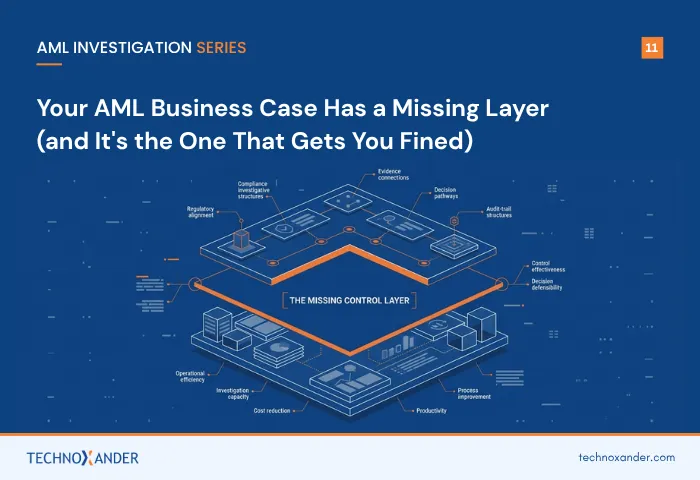
A complete business case covers three layers, not one: the direct cost of analyst time spent on manual data assembly, the regulatory risk cost of investigation decisions that can’t be shown to be consistent or defensible, and the scalability cost of an operating model that can’t absorb rising alert volumes without proportional headcount. Most procurement cases stop at the first layer, which is why they stall at board level.
Most AML business cases are built on one number: the cost of analyst time. That is not wrong, but it is incomplete, and the layers it leaves out are the ones that actually determine whether the investment is justified at board level.
Why isn’t analyst time savings alone enough to justify AML investigation AI?
Because a CFO evaluating cost savings alone is comparing a software cost against a headcount cost, which is a hard case to win on its own. The stronger case adds what a compliance failure costs and what an unscalable operating model costs as volumes grow, both of which are usually larger than the direct cost line.
Layer One: Direct Investigation Cost
The visible cost is analyst time per case. A financial institution running a manual investigation operation, whether regulated in the UK, US, EU or Middle East, is typically paying for a significant share of each analyst’s working day to do work that is not analysis. Industry benchmarking consistently shows that investigators in manual environments spend the majority of their time on data gathering and case assembly before they reach a point of genuine decision-making. The investigation itself, the reasoning, the judgement, the narrative, represents a fraction of the total case time.
Calculate cost-per-case for your current operation: total team cost (salaries, benefits, management overhead, system licences) divided by annual case volume. The result is rarely comfortable. A team of ten investigators handling 8,000 cases a year has a cost-per-case that reflects not just their analysis time but every minute spent switching systems, copying identifiers, and manually assembling context the investigation platform should have surfaced automatically. Investigation friction, the overhead between opening an alert and reaching a decision, is the cost driver, and it’s the line item investigation AI directly reduces.
This is the layer most business cases address, and it’s the right starting point, but stopping here understates the case significantly.
Layer Two: Regulatory Risk Cost
This is the layer most business cases omit, and the one that tends to produce the largest numbers when quantified properly. Since 2021, the FCA has imposed 13 fines totalling over £300 million on banks for AML systems and controls failings, and the pattern is consistent: it is the investigation operation that fails, not simply the detection layer. The £42 million fine issued to Barclays in July 2025 makes this explicit: the FCA found that Barclays failed to conduct proper ongoing monitoring even after receiving law enforcement information about suspected money laundering through a client. The intelligence was there. The investigation process did not act on it.
Do AML fines usually come from detection gaps or investigation failures?
More often the latter. The FCA’s enforcement record shows that material AML fines are rarely caused by detection gaps alone. They are caused by investigation processes that could not demonstrate the quality, consistency or scalability of their decision-making under regulatory scrutiny. FinCEN’s enforcement actions in the US and supervisory findings from EU and Middle East regulators show the same pattern: the fine follows a failure to act on intelligence the institution already had, not a gap in what its detection systems flagged.
Poor investigation quality creates regulatory risk in three ways. SAR defensibility: a SAR written under time pressure, from a partial customer picture assembled manually, is a different document from one that reflects full customer intelligence, and the NCA SARs Annual Report 2024/25 consistently notes that low-quality filings reduce the actionability of disclosures. Investigation consistency: when quality depends on individual analyst skill and time availability, the firm’s compliance record is uneven, which the JMLSG Part I guidance frames as a governance expectation, not a best-practice aspiration. Audit trail quality: an investigation that can’t demonstrate how a decision was reached, what evidence was reviewed, and how the customer’s history was considered is a liability in any supervisory visit.
The Three-Layer AML Business Case
| Layer | What it captures | What to measure |
|---|---|---|
| Direct cost | Analyst hours spent on retrieval, not analysis | Cost-per-case, before and after |
| Regulatory risk cost | Exposure from inconsistent, undocumented decisions | SAR quality, audit readiness, escalation documentation |
| Scalability cost | What happens to the model as volumes grow | Capacity headroom at 2x and 3x current volume |
Layer Three: Scalability Cost
This is the layer that tends to close the argument with CFOs and boards when layers one and two have not. Payment volumes at regulated firms across the UK, US, EU and Middle East are growing, regulatory perimeter expansion is broadening the alert universe in each of these markets, and industry compliance cost research consistently shows no material improvement in cost-per-case despite sustained headcount investment.
The scalability question is simple: can your current operating model absorb 3x alert volume without 3x headcount? For most manual investigation operations, the honest answer is no.
Can a manual AML investigation team absorb 3x alert volume without 3x headcount?
Rarely, in practice. Manual workflows scale roughly linearly with volume, since each additional alert needs roughly the same retrieval effort as the last. Investigation AI breaks that link by removing most of the retrieval step, so throughput per analyst rises instead of headcount rising in lockstep with alert volume.
The cold-start problem compounds this. A firm that responds to volume growth by hiring experiences a cold-start cost every cycle: new analysts without institutional memory of prior cases, customer histories, or entity relationships. The investigation quality dip that follows each hiring wave shows up in SAR quality, in triage accuracy, and in the time new investigators need to reach full productivity. Investigation AI that carries institutional memory removes that dependency; the knowledge base grows continuously and doesn’t reset when staff turn over.
What the Business Case Should Measure
A three-layer business case needs metrics at each layer. Layer one: cost-per-case before and after, and analyst time spent on retrieval versus analysis. Layer two: SAR quality score consistency, investigation file audit readiness, and the rate of escalation decisions with fully documented rationale. Layer three: capacity headroom relative to projected volume growth, and cost trajectory under the current model versus an AI-supported model at 2x and 3x current volume.
These metrics need a baseline, and most financial institutions, in the UK and elsewhere, have not measured them formally, which is itself a finding worth noting when building the internal case. Institutions presenting a multi-dimensional investment case, covering investigation efficiency, risk quality and regulatory risk reduction, consistently achieve faster internal approval cycles than those presenting analyst time savings alone. The board conversation is different when the case addresses what happens if you do not invest, not just what you gain if you do.
At TechnoXander, our AML Investigation Intelligence Platform is built to address all three cost layers: reducing investigation friction directly, improving the quality and consistency of investigation decisions, and supporting investigation capacity that scales with alert volume without a proportional headcount commitment. Speak to our team to build the numbers for your firm.
About Author: