What is AML investigation throughput?
AML Investigation throughput is how many alerts a team can investigate to a consistent standard within a given headcount. Most AML operations scale it linearly: alert volume doubles, headcount needs roughly double too. Investigation AI targets that ratio directly, by removing the retrieval work that consumes most of an analyst’s time before they ever reach a decision.
Alert volumes at regulated firms, in the UK and across the US, EU and Middle East, are not going down. Payment volumes are growing, customer bases are diversifying, and regulatory expectations are tightening. The usual response, when investigation load increases, is to add analysts. That model does not scale sustainably.
The more useful question is not whether AI will replace AML analysts. It will not, and regulators will not permit it to. The more useful question is whether AI can let investigation teams absorb materially more volume without a proportional headcount increase every time alert loads grow. That is the scalability argument, and it is the one worth making to a board.
Will AI replace AML investigators?
No. Detection AI and investigation AI both stop short of the decision itself: the analyst still decides whether to close or escalate a case. What AI changes is how much of the analyst’s day goes to retrieving information rather than reasoning about it.
Why Human Judgement Stays in the Loop
Under the FCA’s Senior Managers and Certification Regime, accountability for AML decisions sits with named individuals. The MLRO is personally accountable for the firm’s financial crime controls, including the quality and defensibility of investigation outcomes. That is the UK’s version of a pattern that recurs across every market this affects: US, EU and Middle East frameworks each place named individual accountability on a compliance officer too. Fully automated decision-making in a compliance-critical function would transfer accountability to a system that cannot be held accountable, and regulators will not accept that, in any of these regimes.
The FCA’s Financial Crime Guide is explicit that firms must be able to demonstrate the basis for their AML decisions, and that human oversight of automated outputs is expected in risk-sensitive processes. The EU AI Act classifies certain AI applications in financial services as high-risk and imposes transparency and human oversight requirements that apply directly to AI systems influencing compliance decisions.
Why can’t AML decisions be fully automated, even where the technology allows it?
Because accountability for the decision has to sit with a named, accountable person under SMCR, and a system cannot hold that accountability. Human judgement stays in the loop for regulatory reasons, not out of caution about the technology itself. That is a design parameter, not a temporary limitation.
Where Analyst Time Goes: Manual vs. AI-Supported Investigation
| Dimension | Manual investigation | AI-supported investigation |
|---|---|---|
| Data gathering and case assembly | The majority of case time | Assembled automatically before the analyst opens the case |
| Analysis and decision-making | A minority of case time | The majority of case time |
| What scales with alert volume | Headcount, roughly linearly | Case throughput per analyst |
What AI Actually Changes: Throughput, Not Decision Authority
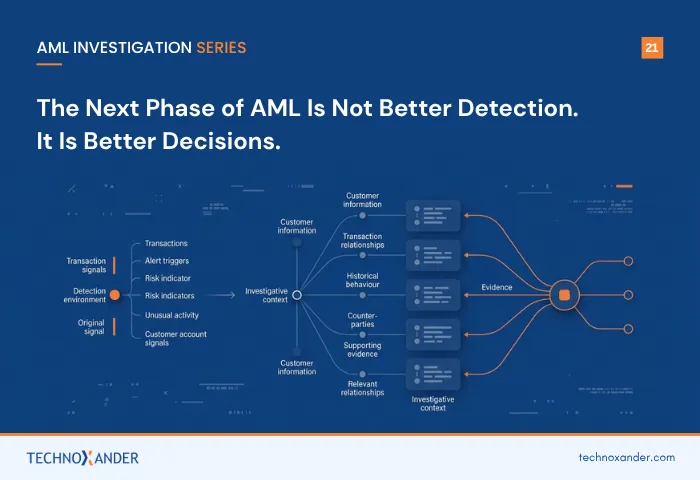
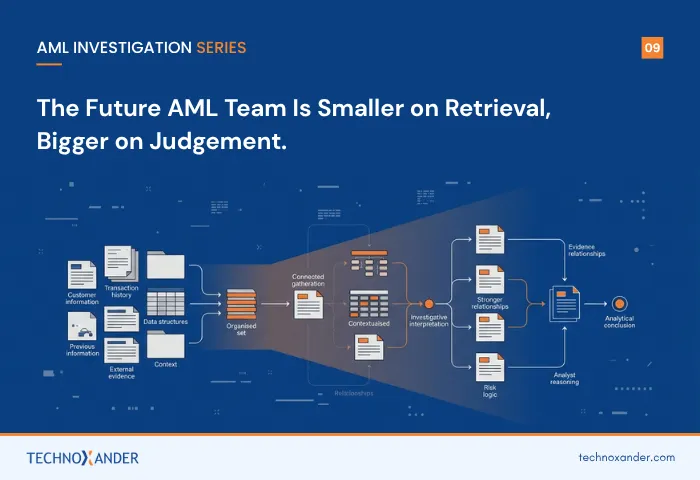
The headcount case for AML AI does not come from automating decisions. It comes from eliminating the overhead that currently consumes most of an investigator’s working time before they reach one. Industry benchmarking consistently shows that analysts in manual investigation environments spend a majority of their time on data gathering and case assembly, not on analysis or decision-making. That overhead is the target, not the judgement.
When investigation AI assembles customer history, surfaces prior cases, connects entity relationships, and generates a structured first-draft case analysis before the analyst touches the keyboard, investigation handling time reduces materially. The analyst reviews the draft, challenges it, adds context, and reaches the decision. The decision stays theirs.
Does reducing retrieval time mean fewer analysts are needed?
Not necessarily fewer. It means the same team can absorb more volume without adding headcount at the same rate the alert queue grows, because a larger share of each analyst’s time goes to the judgement work only they can do.
Despite sustained headcount investment, manual AML investigation workflows have shown no material improvement in cost-per-case, a finding consistent across multiple years of industry compliance cost research.
The Analyst Role That Remains
As AI handles investigation infrastructure, the work that remains for analysts is qualitatively different. Complex cases, multi-entity investigations, novel typologies, cases with ambiguous documentation, and high-value DAML decisions do not reduce. They require deeper human judgement than a system operating under time pressure can consistently provide, and the analyst freed from data retrieval can spend their time on exactly this.
SAR quality improves for the same reason. An analyst who reaches a decision with full customer intelligence already assembled writes a better SAR narrative than one compressing hours of investigation into a short window under alert volume pressure. The NCA receives a more actionable filing, and the institution builds a more defensible compliance record. The case for AI in AML is not that it makes analysts redundant. It changes what analysts are for, from data retrieval and context assembly to genuine risk reasoning and escalation judgement.
The Conversation Worth Having With Your Board
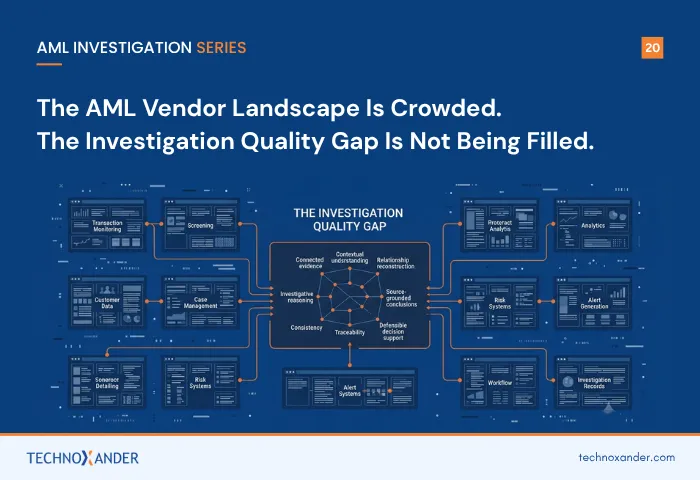
Start from what isn’t in dispute. Investigation AI saves analyst time, and that saving is real and measurable. It is also no longer a differentiator. Every credible vendor in this category claims the same productivity gain, and a board that has heard the pitch before will not approve a business case built on it alone.
Productivity, time savings, and cost savings are the given. The business case is what that gain compounds into. Applied to a single case, it is a cost line. Applied across a growing alert volume, at most regulated firms, payment volumes will keep rising, regulatory scope is expanding, and customer base complexity is increasing, that same per-case efficiency becomes the difference between headcount that scales linearly with alert volume and headcount that does not. The question worth putting to a board is not whether alert volumes will increase. It is whether investigation capacity can keep pace without a proportional staffing increase every time they do.
That is a structural argument, and it holds up under board scrutiny: not “AI will replace investigators,” which is both inaccurate and counterproductive with a compliance audience, but “the same efficiency gain, applied at scale, lets existing teams absorb materially more volume at consistent quality, without the linear cost trajectory that manual workflows produce.”
At TechnoXander, our AML Investigation Intelligence Platform is built around exactly this principle: reducing the retrieval overhead that constrains investigator capacity, so teams can absorb growing alert volumes without proportional staffing increases, and direct analyst time toward the complex cases that genuinely require human judgement. Speak to our team to see what scalable investigation operations look like for your firm.
About Author: