What is investigation AI in AML?
Investigation AI is AI applied at the point an analyst opens an alert, not upstream of it. It aggregates customer intelligence, surfaces prior case dispositions, applies policy-aligned reasoning to the facts of a case, and retains institutional memory from resolved investigations. It is distinct from detection AI, which identifies which transactions get flagged in the first place.
Every AML platform vendor claims to use AI. The claim has become so routine that it has almost stopped meaning anything, and the compliance leaders evaluating these tools need to make decisions that affect investigation quality, regulatory accountability, and operational cost for years.
The question worth asking is not whether a platform uses AI. It is what the AI is actually doing, and at which point in the AML investigation workflow. Get that distinction wrong and you may invest in a capability that improves one layer of your AML programme while leaving the layer that determines outcomes largely unchanged.
The Two Layers Most Vendors Do Not Distinguish
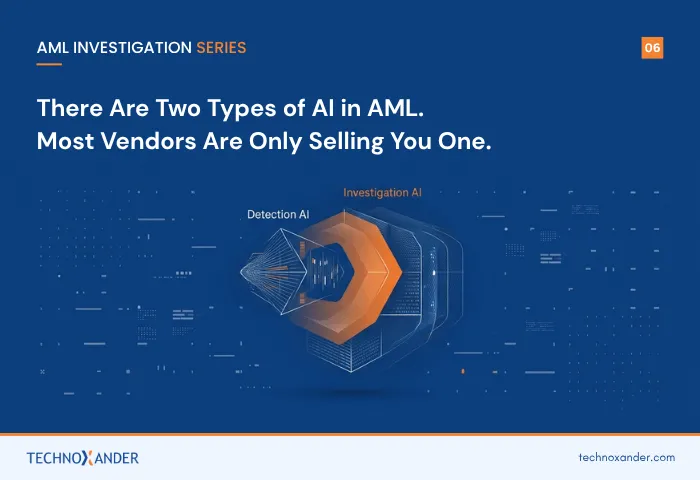
AI in AML operates across two different layers. They address different problems and carry different regulatory implications, and most vendor conversations conflate them.
Detection AI sits upstream of the investigation. It includes machine learning models that identify anomalous patterns across transaction populations and behavioural scoring systems that risk-rank customers dynamically. It has improved meaningfully over the past decade: the best implementations reduce alert volumes and identify typologies that rules-based systems miss.
Investigation AI sits at the point where an analyst opens an alert and decides what to do with it. It aggregates customer intelligence automatically, surfaces prior case dispositions, generates first-draft SAR narratives, and builds organisational memory from resolved investigations. This layer has received far less vendor attention, despite being where the majority of analyst time is spent and where compliance decisions are ultimately determined.
What is the difference between detection AI and investigation AI in AML?
Detection AI sits upstream of the alert and decides what gets flagged. Investigation AI sits at the point an analyst opens the case, aggregating context, surfacing prior dispositions and generating a first-draft rationale. Most vendors compete on the first and say little about the second. More AI in AML does not automatically mean better AML. It depends on which problem the AI is solving.
Detection AI vs. Investigation AI
| Dimension | Detection AI | Investigation AI |
|---|---|---|
| Sits | Upstream, before the alert fires | At the point the analyst opens the case |
| Improves | Alert quality and volume | Investigation completeness and speed |
| What it does | Flags anomalous transactions | Aggregates context and drafts the narrative |
| Vendor attention | High | Low, despite consuming most analyst time |
What Detection AI Does, and Where It Stops
An institution that invests in ML-enhanced transaction monitoring will see alert quality improve as models learn what the institution considers suspicious. False positive rates come down. But the investigation that follows each alert remains structurally unchanged unless the investigation layer is also addressed.
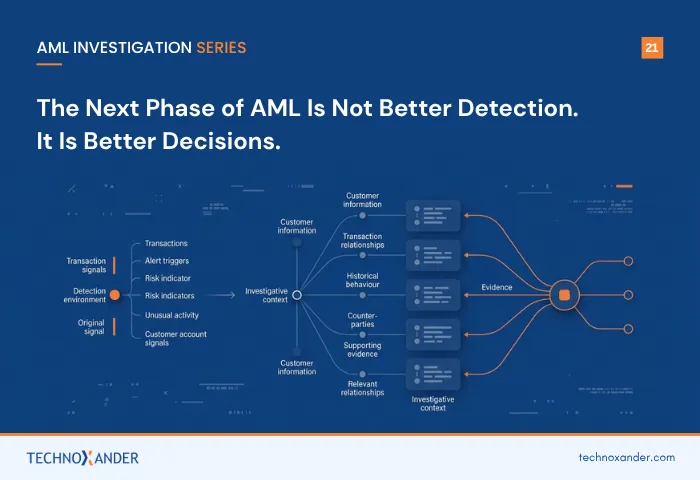
The alert fires. The investigator opens the case and sees a transaction, a rule name, and an account number. The customer’s eight prior alerts are not visible. The counterparty accounts showing correlated inflows are not surfaced. The onboarding note explaining a legitimate income pattern sits in a separate system. The investigator opens four more tabs and starts looking.
Does investing in detection AI improve investigation quality on its own?
Not by itself. Better detection improves which transactions get flagged, but the investigation that follows an alert stays unchanged unless the investigation layer, meaning the context and reasoning available to the analyst, is addressed separately. Industry benchmarking consistently shows that alert-to-SAR conversion rates remain low across the industry, even at institutions that have invested heavily in ML-enhanced monitoring. The detection layer has improved. The investigation friction has not.
What Investigation AI Actually Changes
A well-implemented investigation AI layer aggregates transaction history, onboarding data, prior case records and entity connections into a single view, removing the retrieval overhead that consumes most analyst time in manual workflows. It surfaces typology indicators relevant to the flagged behaviour and applies structured investigative analysis grounded in the firm’s own AML procedures and JMLSG guidance, generating a traceable rationale the analyst can examine and build on.
The result is not automation. It is investigative completeness at the start of the process rather than assembled during it. The analyst still makes the decision. They make it with better information, in less time, with an audit trail that reflects the full picture.
The Explainability Problem Vendors Do Not Talk About Enough
There is a third dimension that gets insufficient attention: regulatory accountability. The FCA’s Financial Crime Guide is explicit that firms must be able to demonstrate the basis for their AML decisions. When an AI system materially influences a compliance decision, the firm must be able to explain that decision under scrutiny. A black-box model that produces outputs without traceable reasoning does not satisfy that standard.
Why does explainability matter for AI used in AML investigations?
The FCA’s Financial Crime Guide requires firms to demonstrate the basis for their AML decisions. An AI system that materially influences a compliance decision, such as a SAR filing or a risk rating, must have its reasoning traceable back to specific records and policy references, not just plausible-sounding output.
FATF’s guidance on AI in AML/CFT names explainability as a prerequisite for responsible AI deployment in financial crime compliance, and the EU AI Act‘s high-risk classification for AI used in financial services reinforces the same expectation: transparency, human oversight, auditability. AI that operates as a black box creates an accountability gap in exactly the area of the firm’s operations that regulators scrutinise most closely.
What to Ask Before You Buy
Vendor demonstrations lead with detection capability: model accuracy, false positive reduction, alert volume metrics. These are meaningful, but not sufficient. The questions that reveal whether AML investigation quality infrastructure is actually present:
- What does an analyst see when they open an alert? Assembled customer intelligence and prior case history automatically, or manual retrieval?
- How does the system incorporate the firm’s own AML policies and JMLSG guidance into its reasoning?
- What happens to institutional knowledge when a case closes: retained, or discarded?
- Can every AI-influenced decision be explained in plain terms to an FCA supervisor, with a complete audit trail?
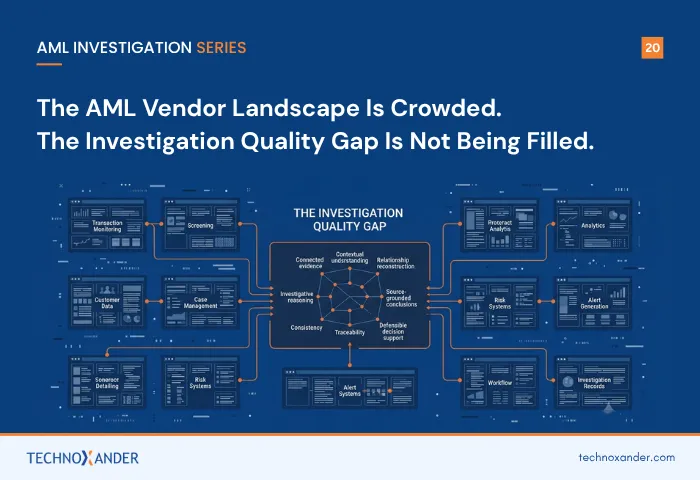
Many platforms marketed as AI investigation tools still leave investigators manually assembling most of their context. The detection layer is smarter. The investigation experience is largely unchanged. Whether the institution answers to the FCA, FinCEN, an EU regulator or a Middle East central bank, the difference between those two things is material, and worth understanding before the contract is signed.
At TechnoXander, our AML Investigation Intelligence Platform is built specifically around the investigation layer: it aggregates customer context automatically and generates a traceable, policy-aligned investigative rationale the analyst reviews and takes ownership of, so decisions stay defensible under FCA scrutiny. Speak to our team to see what investigation AI looks like in practice.
About Author: