What is AML scaling failure?
AML Scaling failure is what happens when a firm’s AML investigation capacity stays fixed while its transaction and alert volumes keep growing. It does not look like a sudden control breakdown. It looks like triage thresholds quietly rising, investigation time per case quietly falling, and SAR quality quietly thinning, until a regulator reviews a period the firm has already outgrown.
The FCA’s July 2025 action against Monzo was not, at its core, a story about bad intent. It was a story about a compliance programme that did not grow at the same rate as the business it was supposed to protect.
That is a different kind of failure, and a more important one to understand. Negligence and deliberate evasion are edge cases. A programme that worked at one scale and became inadequate at another is the mainstream failure mode, and it is the one most scaling firms are walking towards right now without recognising it. Most AML programmes are designed for the size the firm was, not the size it is becoming, whether that firm sits under UK, US, EU, or Middle East supervision.
Does AML scaling failure only happen to UK firms?
No. It is a function of growth outpacing AML investigation infrastructure, which happens to fast-growing regulated firms in any jurisdiction. The FCA‘s Monzo case is simply the most fully documented public example, and its lessons apply just as directly to a US money transmitter or an EU payment institution scaling through the same volume curve.
What Scaling Failure Actually Looks Like
It does not arrive as a sudden collapse. It arrives incrementally, across compounding failure points.
Alert volume outpaces investigation capacity. As transaction volumes grow, alert queues grow faster. Most firms respond by triaging more aggressively: raising thresholds, creating disposition shortcuts, applying blanket closures to alert categories that would previously have warranted individual review. Each response is locally rational under time pressure. Cumulatively, they shift the investigation posture from analytical to mechanical.
Investigation quality degrades under volume. When investigators run at or above sustainable capacity, the quality of individual investigations falls. The manual data assembly that was already a friction point, switching between systems, copying identifiers, retrieving prior case records, becomes the primary consumer of the investigation window rather than reasoning.
A concrete picture: A regulated firm processes 400,000 monthly transactions with a team of six investigators managing a steady alert queue. Transaction volumes double over 18 months, a common growth trajectory for EMIs and challenger banks in any of these markets. Alert volume rises by roughly the same ratio. Without a proportionate increase in AML investigation infrastructure, each investigator now effectively handles twice the caseload with the same tools and time. Case quality does not halve uniformly. It erodes unevenly, with the most complex cases suffering most because they require the most manual assembly.
SAR quality declines as a downstream consequence. The NCA’s SARs Annual Report 2025 consistently flags the quality gap in SAR filings as a structural constraint on law enforcement’s ability to act on financial intelligence. A SAR is only as good as the investigation it summarises. When AML investigation quality compresses under volume, narratives become thinner: less contextual, less specific, less useful to the analyst at the other end.
Institutional memory fails to transfer as teams grow. New investigators do not carry the pattern recognition experienced colleagues have accumulated. In most programmes, that knowledge lives in the heads of senior analysts rather than in the workflow itself. As caseloads grow and mentoring time compresses, the transfer stops happening, and consistency of investigation quality, a specific FCA expectation under the Financial Crime Guide, becomes harder to demonstrate as the team scales.
Is hiring more investigators the fix for scaling failure?
Not on its own. Adding headcount addresses queue depth, but it does not address the manual retrieval overhead that consumes investigation time at every volume level, the cold-start problem every new investigator faces, or the institutional memory that never transfers because it is not embedded in the workflow.
The Monzo Case and What It Actually Reveals
The FCA’s action against Monzo (July 2025, £21 million fine) will be studied for its enforcement context. The more important lesson is structural: the FCA found that Monzo’s financial crime controls failed to keep pace with customer growth that increased the firm’s base nearly tenfold, from 600,000 to 5.8 million customers. The firm also breached a requirement not to onboard high-risk customers, signing up over 34,000 of them. The FCA stated that “Monzo fell far short of what we, and society, expect.” This was the tenth fine the FCA had imposed on a bank for financial crime control failings in four years. The failings were not the result of controls that never worked. They were the result of controls that had not been updated to reflect the business the firm had become.
That is a programme design problem. It reflects an assumption, common across the industry in every market this affects, that AML controls are something you build once and then operate. The reality is that a compliance programme is a dynamic system, continuously re-tested by the business growth around it.
Industry benchmarking research is explicit that AML programmes should be reviewed and updated in response to material changes in business risk, including volume growth. JMLSG Part I guidance frames this as a proportionality requirement: controls should be commensurate with the nature, scale, and complexity of the firm’s activities. US and EU AML frameworks build in the same proportionality principle under their own risk-based supervision models, and scale is not a static variable under any of them.
Where Scaling Failure Shows Up First
| Failure point | Early warning sign | What good infrastructure prevents |
|---|---|---|
| Alert triage | Thresholds quietly rising | Volume growth absorbed without threshold creep |
| Investigation depth | Time-per-case falling | Context assembled automatically, not retrieved manually |
| SAR quality | Narratives getting thinner | Investigation depth holds regardless of volume |
| Institutional memory | New hires repeating past mistakes | Prior reasoning surfaced to every investigator |
Where Most Firms Set the Trip Wire
The typical response to scaling pressure is reactive: hire more investigators when the queue becomes unmanageable, add monitoring rules when an audit flags gaps, update procedures when a supervisory review raises concerns. None of these responses is wrong in isolation. The problem is timing. By the time the queue is visibly unmanageable, AML investigation quality has already degraded, and the filing record for the preceding period already reflects it.
Reactive compliance investment is consistently identified as one of the primary drivers of regulatory exposure in scaling financial services firms, in every jurisdiction with a supervised AML regime. The cost of inadequacy is not just remediation. It is the supervised period that follows, during which the firm operates under enhanced scrutiny with reduced operational freedom. The firms that avoid this trajectory are not the ones that respond faster when problems emerge. They are the ones that design AML investigation infrastructure to scale from the outset.
What Scalable Investigation Infrastructure Actually Requires
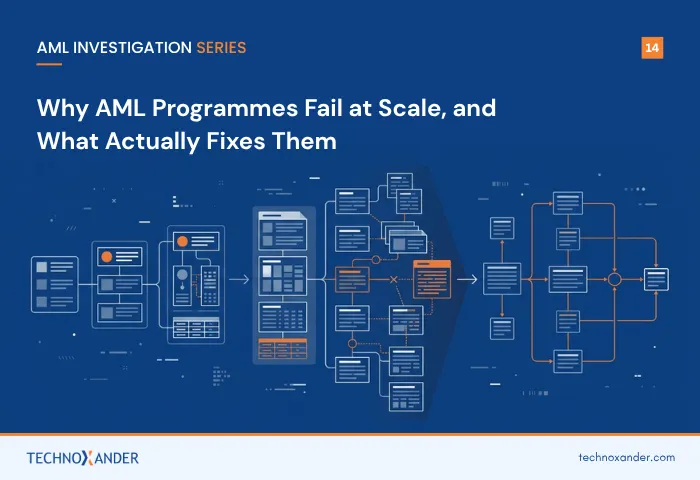
Fixing AML scaling failure is not primarily a resourcing problem. It requires assembling customer context automatically before the investigator opens a case, removing the retrieval overhead that compounds under volume. It requires surfacing prior investigation reasoning alongside new alerts, so new hires have institutional knowledge from day one. And it requires generating traceable investigative rationale for every decision, so the audit trail holds up regardless of which investigator handled the case or when.
The question is not whether an AML compliance programme can survive rapid growth. It is whether the AML investigation infrastructure underneath it was built to scale, or built to work at the size the firm was two years ago.
At TechnoXander, our AML Investigation Intelligence Platform is designed to scale with the business, removing investigation friction structurally rather than absorbing it through analyst overhead. Speak to our team to see what scalable investigation infrastructure looks like in practice.
About Author: