What is a DAML request?
A Defence Against Money Laundering (DAML) request asks the NCA for consent to proceed with a transaction a firm suspects may involve criminal property. The NCA has seven working days to respond. Without that consent, the firm’s usual statutory defence against a money laundering offence does not apply to the transaction it goes on to process.
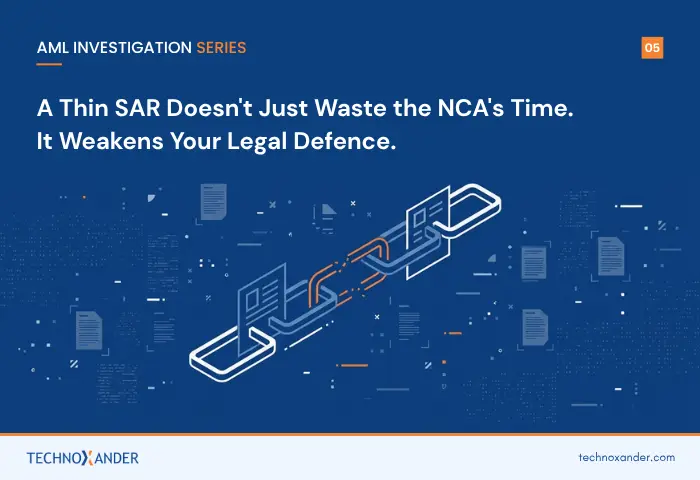
SAR quality has a specific legal dimension that sits beyond regulatory optics, and it is rarely discussed plainly. Our earlier article on what makes a SAR useful to the NCA covers the basics. This article covers what a thin one costs the firm that filed it.
Four Risks a Weak SAR Creates
The consent timing risk. When a firm submits a DAML request, asking the NCA for consent to proceed with a transaction it suspects may involve criminal property, the NCA has seven working days to respond. A DAML built on a thin or incomplete SAR gives the NCA less to work with. Where the intelligence is insufficient, the decision timeline becomes unpredictable at exactly the moment operational certainty matters most.
How long does the NCA have to respond to a DAML request?
Seven working days from a compliant request. If the NCA does not refuse consent within that window, the firm may proceed with the transaction. A DAML built on a thin or incomplete SAR gives the NCA less to work with inside that window, which is what makes the decision timeline unpredictable.
The legal exposure risk. If a transaction proceeds and later proves to involve criminal property, the firm’s statutory defence under the Proceeds of Crime Act 2002 depends on the quality of the intelligence it submitted. A vague SAR does not constitute a robust defence. It constitutes a record of what the firm chose not to include.
Does a thin SAR affect a firm’s legal defence under POCA?
Yes. The firm’s statutory defence under the Proceeds of Crime Act 2002 depends on the quality of the intelligence it submitted. A vague SAR is a record of what the firm chose not to include, not a robust defence.
The regulatory scrutiny risk. The FCA’s Financial Crime Guide expects firms to have systems and controls that ensure SARs fulfil their legal obligations, not just their filing obligations. That standard is not met by volume. It is met by content.
The MLRO sign-off risk. Most SARs are reviewed by the MLRO before submission. An MLRO reviewing a thin narrative cannot add facts the investigator did not surface. They can only sign off on what they were given, or send it back and lose time the DAML clock is already spending.
Who is responsible for reviewing a SAR before submission?
Most firms route the SAR through the MLRO before it is submitted. The MLRO can only sign off on the facts the investigator surfaced. They cannot add missing detail themselves without sending the case back, which is exactly what a thin narrative forces them to do.
The Four DAML-Adjacent Risks of a Weak SAR
| Risk | What a thin SAR creates |
|---|---|
| Consent timing | The NCA has less to work with inside its seven-day window, so the decision timeline becomes unpredictable |
| Legal exposure | The firm’s POCA statutory defence depends on the quality of what it submitted |
| Regulatory scrutiny | The FCA expects SARs to meet their legal obligations, not just their filing obligations |
| MLRO sign-off | The MLRO can only sign off on what the investigator gave them, or send it back and lose time |
The NCA’s SARs Annual Report shows that DAML requests represent a small but operationally critical share of total submissions. Getting them wrong, through incomplete entity intelligence, missing transaction timelines, or narratives that describe behaviour without explaining its significance, is a risk that sits well outside the compliance dashboard.
What Reduces the Risk
Each of these four risks traces back to the same root cause: the investigator did not have complete context in front of them at the point of writing. A DAML request built from a well-supported SAR gives the NCA a clear basis to decide quickly, gives the firm a defensible record under POCA, gives the FCA evidence of a working control, and gives the MLRO something they can sign off on with confidence rather than send back. DAML and POCA are the UK’s specific mechanism, but the underlying principle, that a firm’s legal protection depends on the quality of the intelligence behind its filing, holds under the safe-harbour provisions US institutions rely on with FinCEN and the equivalent consent and defence regimes firms navigate across the EU and Middle East.
At TechnoXander, our AI-powered AML Investigation Intelligence platform surfaces the customer context, prior case history and entity connections investigators need to build a complete SAR at the point of investigation, before it ever reaches the MLRO or a DAML deadline. Speak to our team to see how it works in practice.
About Author: